
Highlights
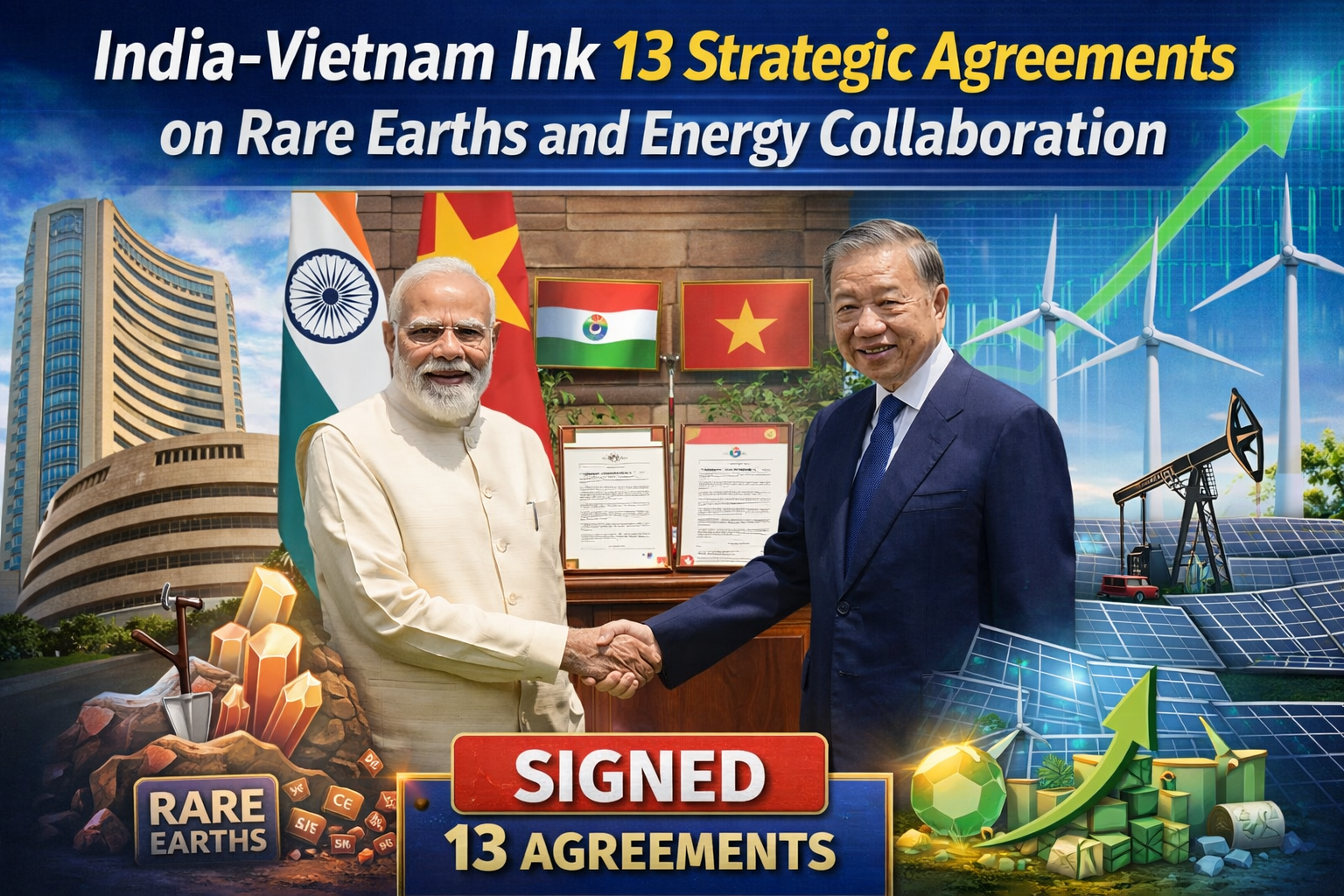
- India-Vietnam partnership strengthened with 13 strategic agreements focusing on rare earths and energy collaboration.
- Rare earth cooperation expands to reduce supply chain dependence and boost technology and manufacturing capabilities.
- Energy sector collaboration grows with focus on renewables, sustainability, and long-term economic growth.
In a move that signals a deepening of ties between two fast-growing Asian economies, India and Vietnam have signed 13 strategic agreements focused on rare earth minerals and energy cooperation. The development marks a significant milestone in the evolving India-Vietnam partnership, reflecting a shared vision to strengthen economic resilience, diversify supply chains, and enhance regional stability.
The agreements come at a time when global competition for critical resources like rare earth elements is intensifying. These minerals are essential for modern technologies, including electric vehicles, renewable energy systems, electronics, and defense applications. By joining hands, India and Vietnam are positioning themselves as key players in the global value chain while reducing dependence on limited suppliers.
This collaboration is not just about trade it represents a broader alignment of strategic interests, economic priorities, and long-term growth ambitions. As both countries look to navigate an increasingly complex global environment, the expansion of the India-Vietnam partnership offers a framework for mutual growth and cooperation.
Expanding Cooperation in Rare Earths and Critical Minerals
Rare earth elements have become the backbone of modern industrial economies, powering everything from smartphones to wind turbines. However, global supply remains highly concentrated, creating vulnerabilities for countries that rely heavily on imports.
Recognizing this challenge, India and Vietnam have placed rare earth collaboration at the heart of their agreements. Vietnam is known to possess significant reserves of rare earth minerals, while India brings expertise in processing, technology, and a growing manufacturing ecosystem. This complementary strength forms the foundation of the expanded India-Vietnam partnership.
Through these agreements, both nations aim to develop a more integrated approach to exploration, extraction, and processing of rare earth resources. This includes joint ventures, technology sharing, and investment in infrastructure that supports sustainable mining practices.
The focus is not only on increasing production but also on ensuring that the entire value chain—from raw material extraction to finished products—is developed within the partnership. This reduces reliance on external markets and enhances supply chain security, a critical priority in today’s geopolitical climate.
Additionally, the collaboration is expected to open new opportunities for businesses in both countries. Indian companies may gain access to Vietnam’s mineral resources, while Vietnamese firms can benefit from India’s technological capabilities and expanding market demand.
Energy Collaboration Driving Sustainable Growth
Energy security and sustainability have become central concerns for economies worldwide. As countries transition toward cleaner energy sources, partnerships that facilitate knowledge sharing and investment are increasingly important.
The agreements between India and Vietnam include significant provisions for cooperation in the energy sector, further strengthening the India-Vietnam partnership. This includes collaboration in renewable energy projects such as solar and wind power, as well as traditional energy resources to ensure stability during the transition phase.
India’s experience in scaling renewable energy capacity, combined with Vietnam’s growing energy demand and resource potential, creates a natural synergy. Both countries are expected to work closely on developing energy infrastructure, improving grid connectivity, and promoting energy efficiency.
Another important aspect of this collaboration is the focus on innovation. By sharing research and technological advancements, India and Vietnam aim to accelerate the adoption of clean energy solutions. This not only supports environmental goals but also contributes to economic growth by creating new industries and job opportunities.
The energy agreements also reflect a broader commitment to reducing carbon emissions and meeting global climate targets. As part of the India-Vietnam partnership, both nations are aligning their strategies to ensure that growth is sustainable and inclusive.
Strengthening Strategic and Economic Ties
Beyond rare earths and energy, the signing of 13 agreements underscores a broader strengthening of bilateral relations. The India-Vietnam partnership has been steadily evolving over the years, driven by shared interests in trade, security, and regional cooperation.
These agreements are expected to boost bilateral trade, which has already been on an upward trajectory. By facilitating easier access to resources, technology, and markets, the partnership creates a conducive environment for businesses to expand and innovate.
Another key dimension of this collaboration is its strategic significance. Both India and Vietnam play important roles in the Indo-Pacific region, and closer ties contribute to regional stability and balance. The agreements signal a commitment to working together on issues of mutual concern, including economic security and sustainable development.
The partnership also opens doors for greater people-to-people engagement, academic collaboration, and cultural exchange. As ties deepen, there is likely to be increased interaction between industries, institutions, and communities in both countries.
Importantly, the agreements reflect a long-term vision rather than a short-term arrangement. By focusing on sectors that are critical to future growth, the India-Vietnam partnership is laying the groundwork for sustained collaboration in the years to come.
A Strategic Response to Global Shifts
The timing of these agreements is significant. The global economy is undergoing major shifts, with countries seeking to diversify supply chains and reduce dependence on a limited number of suppliers. Critical minerals and energy resources have become central to this transition.
In this context, the India-Vietnam partnership serves as a strategic response to emerging challenges. By working together, both nations can mitigate risks associated with supply disruptions and create more resilient economic systems.
The collaboration also reflects a broader trend of regional partnerships gaining importance in global trade. As geopolitical dynamics evolve, countries are increasingly looking to build alliances that support their economic and strategic interests.
For India, strengthening ties with Vietnam aligns with its broader “Act East” policy, which aims to enhance engagement with Southeast Asia. For Vietnam, the partnership with India provides an opportunity to diversify its economic relationships and tap into new markets.
Opportunities for Businesses and Investors
The agreements are expected to create significant opportunities for businesses and investors in both countries. Sectors such as mining, manufacturing, energy, and technology stand to benefit from increased collaboration.
Indian companies may find new avenues for investment in Vietnam’s resource sector, while Vietnamese businesses can explore opportunities in India’s rapidly growing market. The India-Vietnam partnership provides a platform for joint ventures, technology transfer, and capacity building.
Moreover, the focus on sustainable practices ensures that growth is aligned with environmental and social goals. This is particularly important for investors who are increasingly prioritizing sustainability in their decision-making.
The agreements also signal policy stability and a commitment to long-term collaboration, which are key factors in attracting investment. As both countries continue to strengthen their partnership, the business environment is likely to become more favorable for cross-border ventures.
Conclusion
The signing of 13 strategic agreements between India and Vietnam marks a new chapter in their bilateral relations. By focusing on rare earths and energy collaboration, the two nations are addressing some of the most critical challenges facing the global economy today.
At the heart of this development is the growing India-Vietnam partnership, which reflects a shared commitment to economic resilience, sustainability, and regional cooperation. The agreements not only strengthen ties between the two countries but also position them as key players in the global landscape.
As the world continues to navigate uncertainty, partnerships like this will play a crucial role in shaping the future of trade, technology, and energy. For India and Vietnam, this collaboration is more than just a set of agreements it is a strategic investment in a shared future.
Visit Augmenting Money for the most recent information.
Leave a Reply