
Highlights
- Geopolitical Supply Tensions: G7 leaders are forced to aggressively pivot following Beijing’s restrictive export controls on rare earth permanent magnets, tungsten, and antimony, prompting a renewed focus on the G7 critical minerals strategy aimed at securing diversified and resilient supply chains.
- Economic Sovereignty Imperative: Host nation France pushes for strict price supports, subsidies, and guaranteed purchase agreements to shield alternative mining investments from Chinese dumping.
- Trading Bloc Fragmentations: Internal friction remains high as European nations express deep skepticism over a U.S.-proposed critical minerals trading bloc built on protectionist architectures.
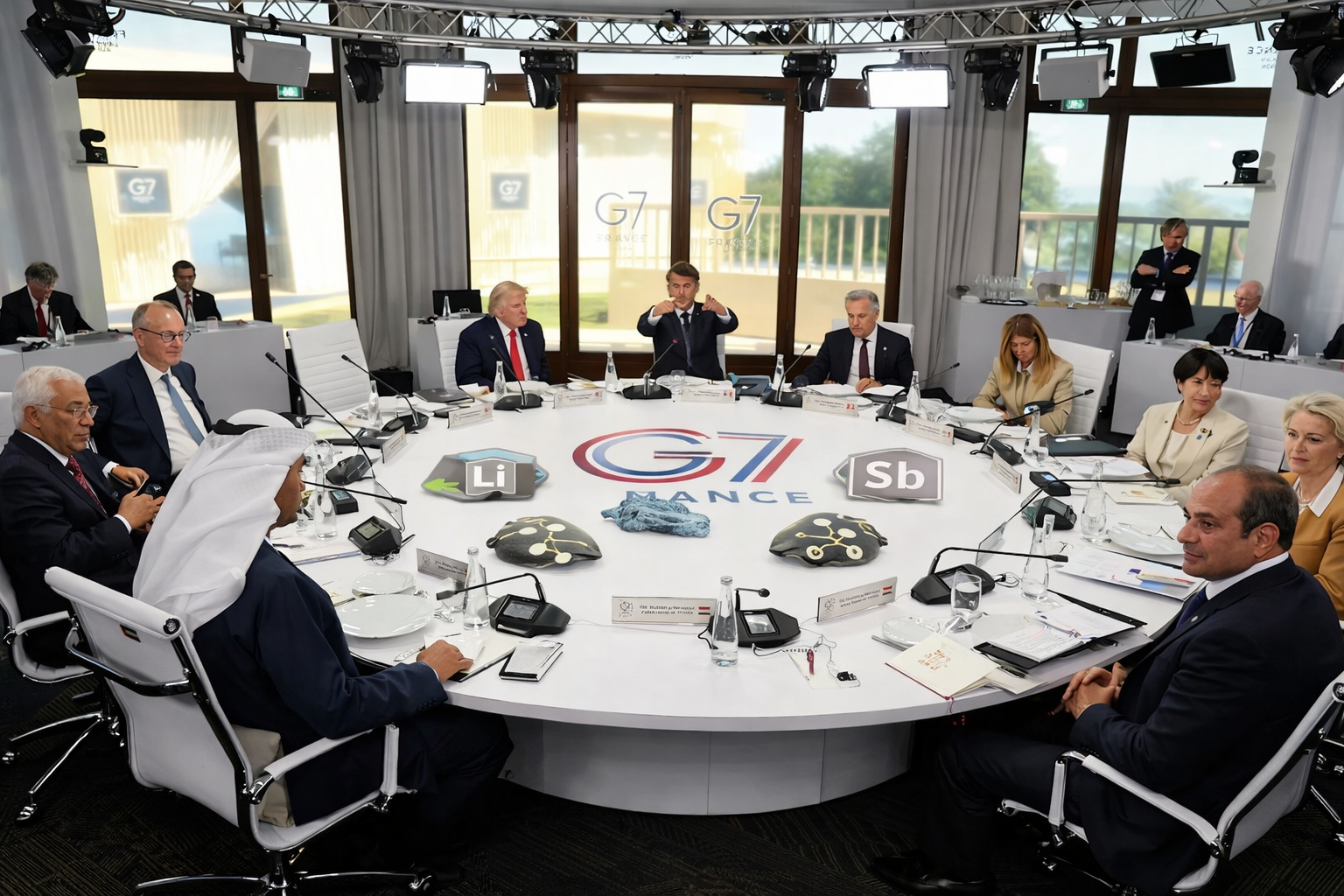
The structural foundations of international trade and sovereign industrial security are undergoing a major realignment as the world’s most advanced economies move to secure the raw components of the modern digital era. Meeting on the final day of the historic three-day summit in Evian-les-Bains, France, the heads of state representing the Group of Seven (G7) have focused their collective attention on a glaring economic vulnerability.
Under the direction of the French presidency, which has made supply chain resilience its primary focus, member states have finalized a sweeping joint declaration. This comprehensive policy manual formally introduces an aggressive G7 critical minerals strategy designed to protect Western technological sovereignty and systematically build a brand-new, independent network for extracting, refining, and recycling rare earth materials.
The strategic urgency of this multi-lateral economic intervention is directly driven by a growing sense of panic among Western energy, defense, and technology manufacturing sectors. For decades, Western powers prioritized corporate efficiency and low production costs, allowing the processing of essential materials to concentrate in East Asia.
This prolonged complacency triggered a severe wake-up call when Beijing abruptly implemented tight export restrictions on permanent magnets made of rare earths, nearly paralyzing major industrial hubs overnight. By directly challenging this geographic concentration, the newly revealed G7 alliance intends to eliminate an unsustainable China mineral dependence that currently exposes critical Western industrial sectors to severe supply chokepoints and geopolitical manipulation.
Diplomats working behind the scenes at the summit emphasize that this coordinated text represents a definitive shift away from purely theoretical discussions toward hard, state-backed industrial policy. French presidential officials noted before the final sessions that the negotiated texts are directly linked to the broader concept of economic sovereignty.
While global manufacturing requirements continue to expand rapidly, the initial measures agreed upon are explicitly positioned as the first phase of a decades‑long decoupling effort. By building a ring‑fenced economic perimeter, Western leadership aims to provide private institutional capital with the clear guarantees and market stability required to open up new, high‑capacity alternative extraction sites across friendly partner nations, reinforcing the G7 critical minerals strategy as a cornerstone of this long‑term transformation.
Deconstructing Market Standards, Subsidy Wars, and Transatlantic Divergences
A closer analysis of the operational pillars supporting this new policy roadmap reveals a complex mix of financial guarantees and state-backed market interventions. To shield Western mining firms and private infrastructure developers from predatory pricing and aggressive market dumping, the G7 framework introduces price supports and guaranteed purchase contracts.
These defensive financial structures are designed to prevent state-backed Chinese producers from artificially crashing global mineral prices a predatory tactic historically used to drive newer, non-Chinese mining operations into bankruptcy. Furthermore, by establishing strict new environmental, social, and governance (ESG) market standards for mineral processing, the G7 is attempting to create a premium, ring-fenced market tier that rewards sustainable, transparent mining operations outside of China.
However, the path toward a completely unified Western supply network faces significant friction due to growing disagreements over trade governance between the United States and its European allies. Earlier this year, the U.S. administration proposed an exclusive, preferential critical minerals trading bloc powered by advanced AI pricing models. Yet, several European governments have openly pushed back against this American plan, expressing deep concerns that Washington’s protectionist trade policies could give U.S. domestic manufacturers an unfair competitive advantage while distorting international commodity markets, underscoring the challenges in advancing a cohesive G7 critical minerals strategy.
European Commission President Ursula von der Leyen highlighted this delicate balance, reiterating that Europe’s core strategy remains focused on targeted “de-risking” rather than a chaotic, blanket decoupling from the global economic ecosystem.
Counter-Dumping Protections and Global Resource Expansion Initiatives
To directly address these processing deficits and broaden the geopolitical footprint of the alliance, G7 finance ministers have formally expanded their collaboration to include key mineral-producing nations from the Global South. High-level delegations from Australia, India, Indonesia, and South Africa were invited to join the summit’s core working sessions to build a more resilient global network.
As a concrete first step, Japan announced a fresh $20 million contribution to a specialized initiative managed by the Asian Development Bank. This program will deliver targeted technical assistance and infrastructure financing to resource‑rich regions, ensuring that local mining assets remain under diversified ownership rather than being bought up by state‑backed Chinese enterprises, reinforcing the broader G7 critical minerals strategy.
Simultaneously, the European Union is preparing a much more aggressive trade defense system to counter what it describes as a predatory wave of industrial overcapacity flowing from East Asian factories. Following a record trade deficit with China that surpassed €360 billion last year, EU leaders are scheduled to convene a special summit in Brussels to greenlight tougher, systematic trade defense measures.
These powerful trade tools will include retroactive tariffs and strict import caps specifically engineered to protect emerging European battery, wind turbine, and solar manufacturing sites from being wiped out by low-cost, subsidized foreign imports.
From a long-term macroeconomic and geopolitical perspective, this major G7 mineral declaration marks a historic shift in the rules of global trade. For nearly half a century, international corporate strategies prioritized raw supply chain efficiency above all else, naturally concentrating processing infrastructure wherever operational costs were lowest.
Today, that efficiency‑first model is being completely replaced by a new paradigm that prioritizes national security and supply chain resilience. As specialized engineering crews begin building out new processing centers and alternative trade routes over the coming years, the global commodity landscape faces an extended period of intense competition, permanently rewriting the economic balance of power between East and West, with the G7 critical minerals strategy emerging as a central pillar of this transformation.
Visit Augmenting Money for the most recent information.
Leave a Reply