
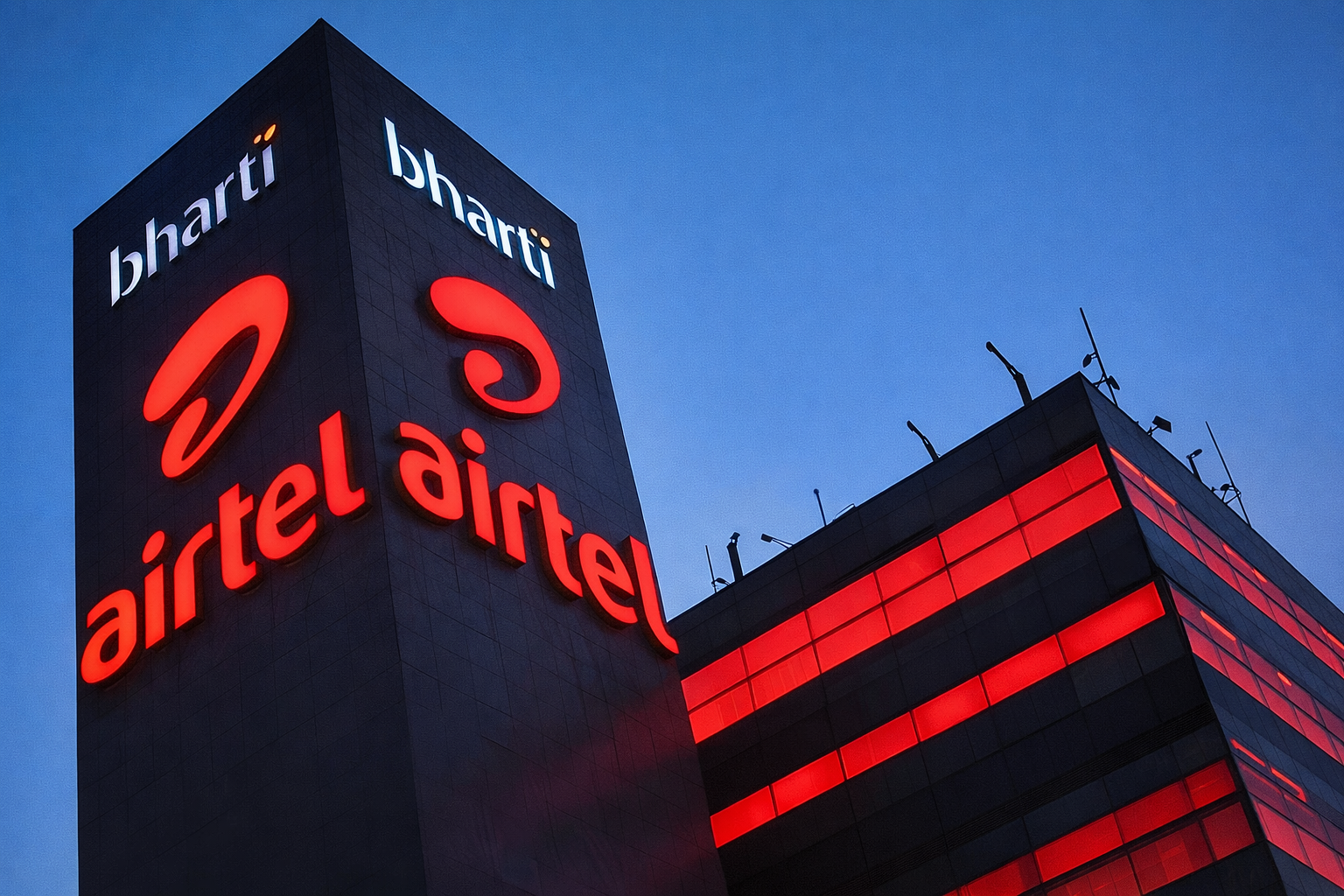
Highlights
- New Market Milestone: Bharti Airtel’s market cap hit an intraday high of ₹11.90 lakh crore, surpassing HDFC Bank to become India’s second most valued firm behind Reliance Industries.
- Growth Divergence: This shift follows a five-year performance gap, where Airtel shares surged 270% compared to a modest 49% return for HDFC Bank amid its mega-merger transitions.
- Bullish Analyst Outlook: Top global brokerages like BofA and JP Morgan maintain a positive outlook on Airtel, citing peaking 5G capex, strong postpaid growth, and rising digital enterprise revenues.
The domestic financial ecosystem witnessed a historic realignment on Monday, May 18, 2026, as telecom behemoth Bharti Airtel Limited surpassed private sector banking giant HDFC Bank Limited to claim the status of India’s second most valued firm by market capitalisation. This symbolic shift on Dalal Street underscores changing investor preferences, a profound re-rating of the Indian telecommunications landscape, and localized operational headwinds inside the banking sector.
During the opening hours of the trading session, Bharti Airtel’s shares extended an impressive winning streak into a fourth consecutive day, scaling an intraday high of ₹1,953.80 on the National Stock Exchange (NSE). This move pushed the company’s aggregate market valuation past the ₹11.85 lakh crore mark, briefly touching a pinnacle of ₹11.90 lakh crore and forcing a major reshuffle in India’s corporate hierarchy.
The financial performance of both corporations highlights a long‑term divergence in investor sentiment and capital allocation strategy. While HDFC Bank has traditionally held an ironclad position as the defensive anchor of institutional portfolios, its stock has experienced considerable valuation compression over the preceding twelve months, creating space for Bharti Airtel to assert itself as the Second most valued firm in India’s corporate hierarchy.
On the very day that Bharti Airtel recorded its multi-session peak, HDFC Bank’s stock slid under structural pressure on the Bombay Stock Exchange (BSE), causing its aggregate market value to drop to approximately ₹11.74 lakh crore. This temporary gap permitted the Sunil Bharti Mittal-led telecom giant to bridge the valuation deficit and secure a historic corporate milestone. The only entity remaining ahead of Bharti Airtel in the domestic market cap sweepstakes is Mukesh Ambani’s Reliance Industries Limited, which maintains its pole position with an estimated valuation of ₹18.08 lakh crore.
This corporate advancement is not merely an isolated consequence of daily trading volatility; rather, it reflects a five-year structural transformation. Over a five-year horizon, Bharti Airtel’s equity has delivered a staggering 270% return to its shareholders, driven by consistent tariff adjustments, market consolidation, and an aggressive rollout of standalone 5G infrastructure.
Conversely, HDFC Bank has provided a relatively modest 49% return over the identical period, significantly underperforming the broader benchmark indices like the Nifty 50 and Sensex. Financial experts suggest that this changing of the guard indicates a fundamental transition where telecom service providers are viewed less as utility utilities and more as high-growth digital infrastructure platforms capable of generating resilient free cash flows.
What is Driving the Exponential Rise in Bharti Airtel’s Market Valuation?
The immediate catalyst behind Bharti Airtel emerging as the second most valued firm lies in its strategic roadmap focused on expanding its average revenue per user (ARPU). Throughout recent quarterly corporate briefings, Bharti Airtel’s executive leadership team has continuously emphasized a dual strategy of premiumization and seamless migration of prepaid customers to high-margin postpaid packages. By prioritizing subscriber quality over sheer volume, the company has successfully expanded its core margins despite the massive capital requirements associated with nationwide 5G infrastructure development. This disciplined approach to monetization has reassured institutional investors that the company is well-positioned to maintain stable returns without overleveraging its balance sheet.
In addition to core mobility operations, Bharti Airtel has derived significant growth from its adjacent business portfolios, particularly its enterprise solutions, digital services, and expanding footprint across the African continent. The company’s international branch, Airtel Africa, has maintained steady operational momentum, providing an effective geographical hedge against localized domestic regulatory or macroeconomic disruptions. Furthermore, structural shifts within the domestic enterprise landscape have increased demand for cloud architecture, cybersecurity systems, and specialized data centers. Bharti Airtel’s strategic infrastructure investments in these adjacent segments are beginning to bear fruit, transforming the organization from a traditional cellular service provider into an integrated technological conglomerate and reinforcing its stature as India’s Second most valued firm.
Another critical factor that has supported investor confidence is the long-term commitment displayed by the company’s core promoters. Chairman Sunil Bharti Mittal recently announced a strategic intent to gradually scale up the promoter entity Bharti Telecom’s direct equity ownership toward a controlling stake of 51% over the next decade, rising from its current holding of just over 40%. Such clear forward guidance on promoter acquisition has acted as a powerful institutional signal, removing overhang concerns and prompting global investment brokerages to revise their long-term target prices upward. This vote of confidence from internal stakeholders has provided an excellent backdrop for the equity’s multi-session rally on the national stock exchanges.
How Underperformance at HDFC Bank Facilitated the Realignment
To fully comprehend how Bharti Airtel successfully secured its position as India’s second most valued firm, it is equally necessary to analyze the underlying operational pressures affecting HDFC Bank. The premier private sector lender has been grappling with an uncharacteristic phase of equity consolidation and market underperformance following its historic mega-merger with parent entity HDFC Limited. The integration of such massive balance sheets has presented prolonged challenges regarding credit-to-deposit ratios and margin stabilization. These technical banking factors have restricted HDFC Bank’s ability to post the premium growth figures that historically justified its premium valuation multiple on Dalal Street.
Furthermore, heightened institutional anxiety surrounding senior leadership transitions has contributed to capital outflows from the banking heavyweight. The sudden resignation of part-time Chairman Atanu Chakraborty introduced an element of corporate uncertainty that the market struggled to price effectively. As the banking institution navigates its complex leadership succession roadmap, institutional fund managers have actively reallocated capital away from financial heavyweights toward sectors with clearer near-term visibility. This institutional rotation out of banking names and into highly resilient digital infrastructure stocks like Bharti Airtel created the ideal conditions for this market cap divergence.
On a year-to-date basis, the contrast between the two market leaders becomes even more apparent. While Bharti Airtel’s stock has weathered global macroeconomic volatility with a manageable correction of approximately 7.5% since the turn of the calendar year, HDFC Bank’s equity value has corrected by more than 22% over the exact same period. This sharp reduction in the bank’s capital base effectively erased its multi-billion-dollar valuation cushion, opening the door for Bharti Airtel to capitalize on its positive momentum and surpass the financial institution in the elite tier of India’s largest listed corporations.
Global Brokerage Perspectives and the Road Ahead for Dalal Street
Prominent international financial institutions and domestic brokerages have weighed in heavily on the significance of Bharti Airtel becoming the country’s second most valued firm. A recent comprehensive research note issued by BofA Securities maintained an optimistic view on the telecom enterprise, assigning an ambitious target price of ₹2,320 per share. The investment firm highlighted that Bharti Airtel is positioned to capture disproportionate market share gains from weakened competitors while simultaneously benefiting from stable, non-cellular revenue lines. Crucially, BofA Securities noted that the business has likely passed its peak capital expenditure cycle for 5G, meaning future revenue gains should flow directly into expanding free cash flows.
In a similar vein, JP Morgan established a long-term target price of ₹2,250 per share, identifying structural deleveraging, steady dividend growth, and high-margin enterprise adjacencies as the primary operational catalysts moving forward. Meanwhile, Goldman Sachs retained a firm “Buy” recommendation on the asset with a 12-month target expectation of ₹2,210, marginally adjusting its near-term model to reflect minor softness in secondary divisions like direct-to-home (DTH) television and cellular towers while upgrading core revenue growth models by 1-2% for fiscal years 2027 through 2030. These widespread institutional upgrades reflect a structural consensus that Bharti Airtel’s newfound premium valuation is firmly supported by underlying operational fundamentals.
As the trading week progresses, the intense competition between Bharti Airtel and HDFC Bank for the coveted second spot is expected to continue on the domestic exchanges. Because the market capitalization gap between the two entities remains exceptionally narrow, minor intraday price movements could see them exchange leadership positions multiple times before a definitive trend emerges. However, regardless of temporary fluctuations, the broader structural narrative has been clearly established. The emergence of a telecommunications powerhouse as a Second most valued firm in Indian market capitalization signals a mature digital economy where connectivity, technology, and data infrastructure have assumed a position alongside traditional financial services at the peak of corporate India.
Visit Augmenting Money for the most recent information.
Leave a Reply