
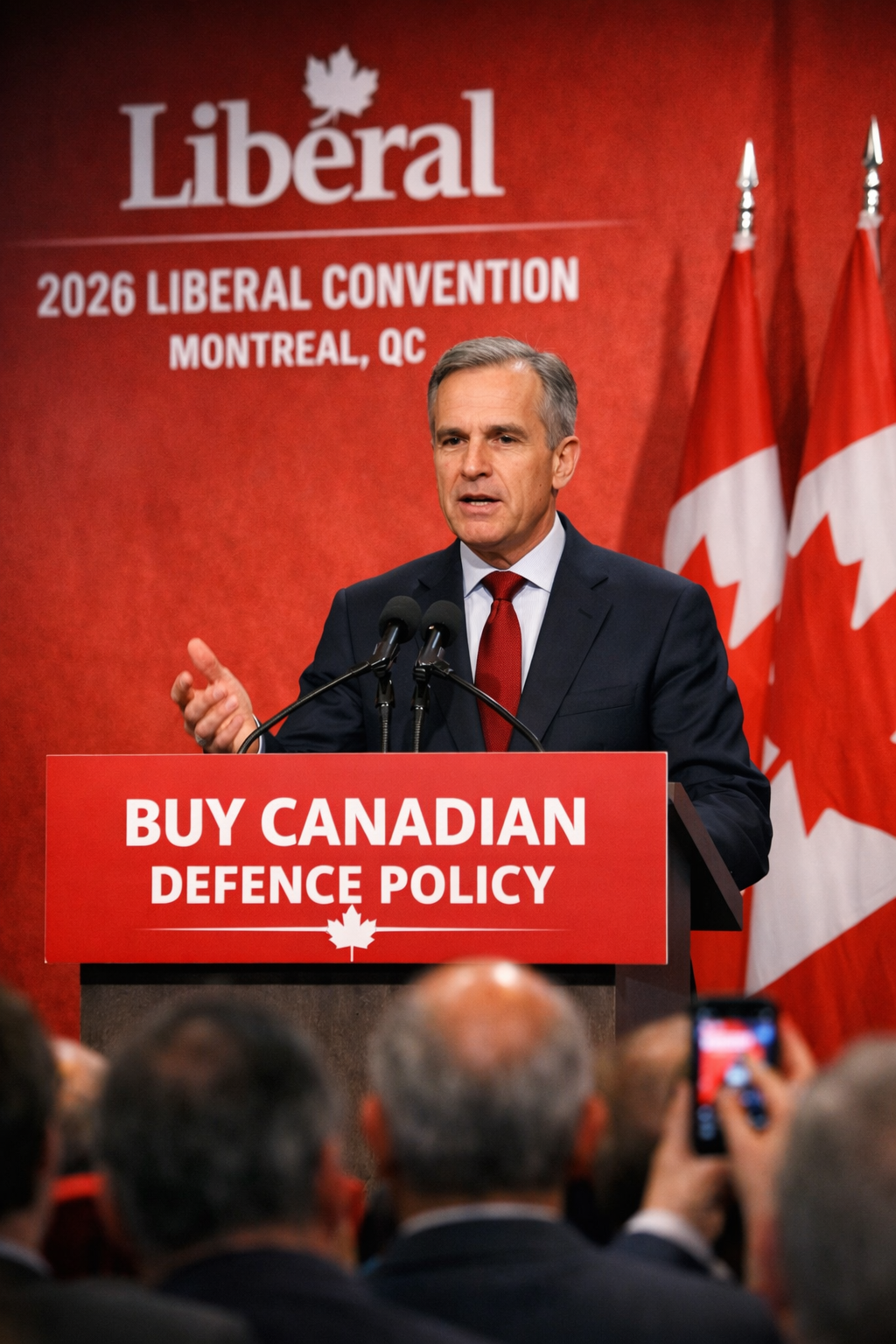
At a pivotal Liberal Party convention in Montreal this April 2026, Prime Minister Mark Carney delivered a speech that will likely be remembered as the “Canadian Declaration of Economic Independence.” With a single sentence “The days of Canada’s military sending 70 cents of every dollar to the United States are over” Carney signaled the end of a decades-old status quo and the beginning of a new era of strategic autonomy.
For the global community, from Indian entrepreneurs looking for new markets to U.S. investors recalculating aerospace portfolios, this is more than just political rhetoric. It is a fundamental restructuring of how one of the world’s largest economies intends to protect its borders and fuel its industries.
The “70 Cents” Era: A Legacy of Dependence
For over half a century, the defense relationship between Ottawa and Washington was characterized by deep integration. While this provided Canada with access to world-class technology, it came at a steep domestic price.
- Financial Drain: Historically, over 70% of Canada’s military capital spending flowed directly into the pockets of American defense giants like Lockheed Martin and Boeing.
- Industrial Stagnation: By outsourcing the majority of its procurement, Canada’s own domestic defense industrial base remained a secondary player, often relegated to providing sub-components rather than lead systems.
- Strategic Vulnerability: The model relied on the assumption of a “forever stable” trade partnership. As protectionist policies and tariffs began to emerge from Washington, this reliance transformed from a convenience into a liability.
The Turning Point: Why Now?
The shift in the Mark Carney defence policy isn’t happening in a vacuum. It is a calculated response to several “cracks” in the North American foundation:
- Trade Friction: Persistent tariffs on Canadian steel and aluminum, particularly those seen during the Trump administration, proved that even the closest allies aren’t immune to trade wars.
- Sovereignty in a Multi-polar World: Carney has argued that Canada can no longer depend on a single ally for its survival. The “rupture” in the postwar order requires middle powers to build their own resilience.
- Economic Stimulus: By redirecting billions of dollars back into the Canadian economy, the government aims to create 125,000 high-paying jobs and grow domestic defense revenue by 240%.
The New Strategy: Flipping the Script
The cornerstone of the new Defence Industrial Strategy (DIS) is a “Buy Canadian” mandate that seeks to flip the historical spending ratio. The goal is clear: 70% of defense contracts must stay within Canada.
Key Pillars of National Resilience
- Raw Material Mobilization: The government will prioritize Canadian steel, aluminum, and timber for all infrastructure and hardware projects.
- High-Tech Expansion: Significant investments are being channeled into Artificial Intelligence, Shipbuilding, Aerospace, and Cybersecurity.
- Strategic Innovation: A new $4 billion Defence Platform at the Business Development Bank of Canada will provide the capital necessary for small and medium-sized enterprises (SMEs) to scale up.
| Policy Feature | The “Old” Way | The “Carney” Way |
| Primary Supplier | United States (70%+) | Canadian Domestic Firms (70% Goal) |
| Economic Focus | Outbound Capital Flow | Domestic Industrial Stimulation |
| Trade Goal | U.S. Integration | Doubling Non-U.S. Exports |
| Key Resource | Imported Tech | Canadian Materials & Workers |
Global Implications: What It Means for You
For Indian Entrepreneurs and Businesses
Canada’s pledge to double its non-U.S. exports over the next decade is a massive green light for Indian trade. As Canada looks to diversify away from Washington under the Mark Carney defence policy, it will seek reliable partners in the Indo-Pacific.
- Opportunity: Indian firms specializing in dual-use technology, software-as-a-service (SaaS) for defense, and supply chain logistics may find a more welcoming Canadian market eager to build non-U.S. alliances.
For US Investors and Contractors
The “Buy Canadian” mandate is a “trade irritant” for the U.S. Trade Representative, but for investors, it represents a shift in where value is created.
- Trend: Expect a surge in joint ventures. American firms may need to establish more significant physical footprints and manufacturing plants in Canada to qualify for contracts under the new “Buy Canadian” rules.
For Global Business Leaders
The US Canada defence ties are not being severed, but they are being re-negotiated. Canada is increasingly looking toward the UK and the EU (and potentially “middle power” allies like India) to fill the gaps.
Expert Perspective
Canada is moving from a posture of ‘buying security’ to ‘building security.’ This isn’t just about tanks and planes; it’s about ensuring that the intellectual property and the industrial capacity remain north of the border. Analysis from the Defence Industrial Strategy release.
Conclusion
The Mark Carney defence policy marks a definitive end to the era of sanguine dependence. By treating military spending as an economic engine, Canada is attempting to decouple its national security from the volatile political winds of its southern neighbor.
Visit Augmenting Money for the most recent information.
Leave a Reply