
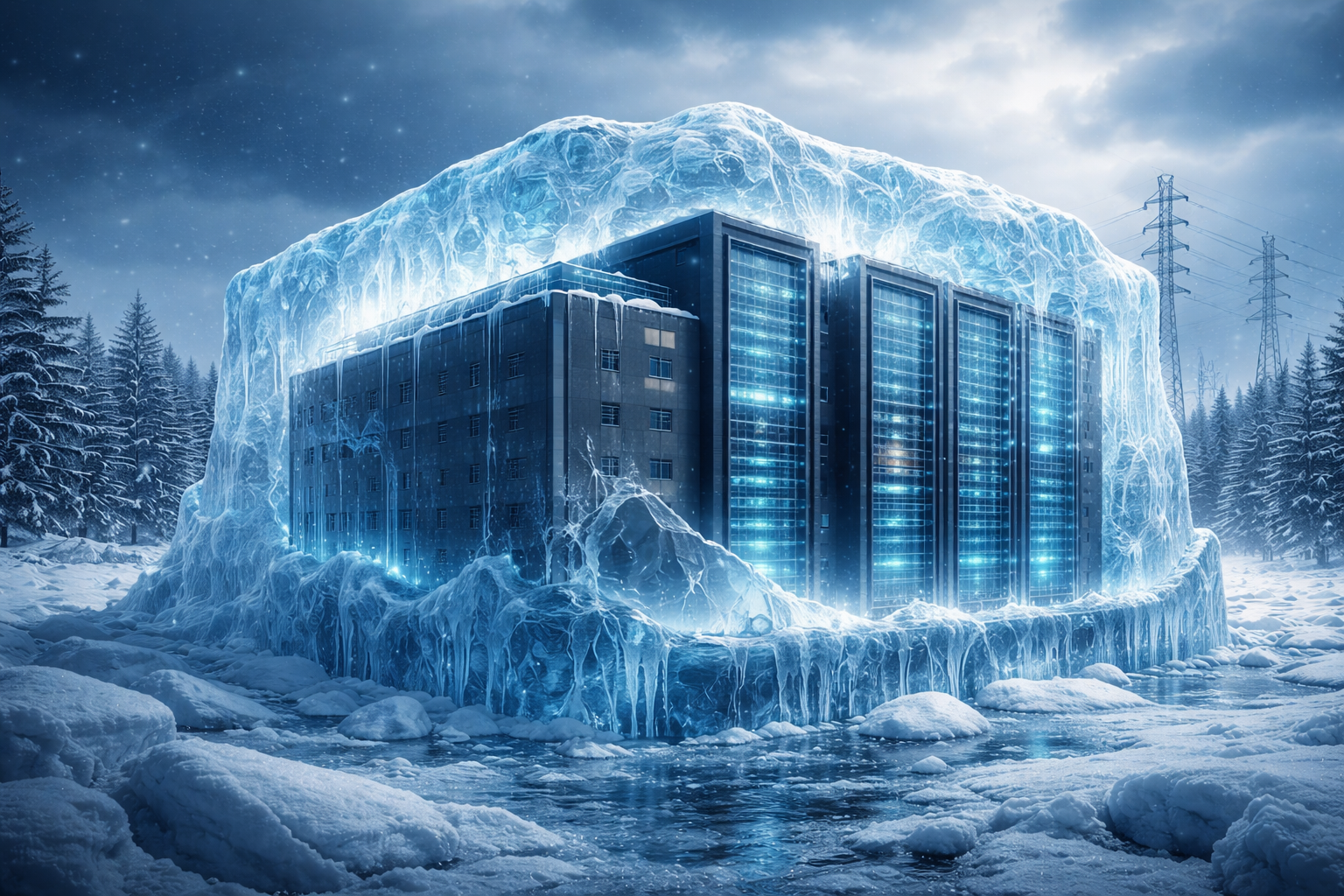
The digital gold rush of the 21st century has hit an unexpected granite wall in the northeastern United States. In April 2026, Maine made history by becoming the first state to advance a statewide moratorium on large-scale data centers. For an industry accustomed to exponential growth, the Maine data center ban represents a chilling “cold front” that could signal a broader national and global shift in how we build the backbone of Artificial Intelligence.
This legislative pause, primarily targeting facilities with a load of 20 megawatts (MW) or more, comes at a time when the world is grappling with an “AI Bottleneck.” It is no longer just about chip shortages or algorithmic efficiency; the bottleneck has moved to the physical world land, water, and, most critically, the power grid.
The Maine Moratorium: Why the Pine Tree State Said “Pause”
The legislation, known as LD 307, was advanced by the Maine House in early April 2026 with an 82-62 vote. The bill institutes a moratorium on the construction of high-capacity AI data centers until November 1, 2027, forming the basis of the Maine Data Center Ban.
Lawmakers, led by Representative Melanie Sachs, argue that the state needs a “breather” to evaluate several critical factors:
- Grid Reliability: A 20MW facility consumes enough electricity to power roughly 15,000 to 20,000 homes. In a state already facing high residential electricity rates, the fear of “grid cannibalization” is real.
- Environmental Legacy: Beyond carbon footprints, concerns have emerged regarding “forever chemicals” (PFAS) used in specialized cooling systems and fire suppressants required for high-density AI servers.
- Ratepayer Protection: Maine officials are wary of residents footing the bill for infrastructure upgrades required to support private tech giants.
“I think Maine is the canary in the coal mine. Maine will be the first of many states to have such moratoria.” Anirban Basu, Chief Economist for the Associated Builders and Contractors.
The “AI Bottleneck”: When Cloud Infrastructure Challenges Meet Reality
For years, the “Cloud” was marketed as an ethereal, weightless concept. In 2026, the reality is far more industrial. The shift from general-purpose cloud computing to AI-intensive workloads has fundamentally changed the power profile of data centers.
Power Density vs. Grid Capacity
Traditional data centers operate at a lower power density per rack. AI training facilities, however, require massive amounts of energy for GPUs (Graphics Processing Units) that run hot and hungry. According to data from 2024, U.S. data centers consumed 183 terawatt-hours of electricity roughly 4% of total power use. That figure is projected to more than double by 2030 creating a scenario where power availability, not hardware, is the primary constraint on AI growth, a concern underscored by the Maine Data Center Ban.
The Geography of Resistance
Maine isn’t alone. As of early 2026, at least 11 other U.S. states, including New York, South Carolina, and Oklahoma, have proposed similar laws to restrict or pause new data center construction. This creates a fragmented map for global tech firms (hyperscalers like Google, Microsoft, and Amazon) who now face a patchwork of local regulations.
Rising Utility Costs
A Bloomberg News analysis found that between 2020 and 2025, electricity costs in areas near major data center hubs soared by as much as 267%. This economic friction is turning local communities against the very infrastructure that powers their digital lives.
Strategic Implications for Global Investors and Entrepreneurs
For U.S. Investors: A Shift in “Site Selection”
The Maine data center ban is a red flag for real estate and infrastructure investors. The era of “build it and they will come” is over. Investors must now prioritize:
- Off-grid Capability: Projects with on-site small modular reactors (SMRs) or massive dedicated renewable arrays will likely bypass these moratoria.
- Secondary Markets: As Maine and Virginia (the world’s data center capital) tighten their belts, attention is shifting to regions with surplus power or cooling-friendly climates that haven’t yet reached their regulatory limit.
For Indian Entrepreneurs: Lessons from the West
India is currently undergoing its own massive data center expansion, driven by the “Digital India” initiative. The Maine situation offers a vital blueprint:
- Sustainable Scaling: Indian entrepreneurs should lead with liquid cooling and green energy partnerships today to avoid the “protectionist” backlash Maine is currently experiencing.
- Data Sovereignty: As the U.S. grid reaches its limit, the global AI workload may shift. India’s ability to provide stable, green power for AI training could make it a primary destination for global “sovereign AI” clouds.
Conclusion: The End of the “Wild West” for Data Centers
The Maine data center ban is more than a local zoning dispute; it is a signal that the physical environment is finally placing boundaries on digital expansion. While Governor Janet Mills has expressed reservations noting that towns like Jay “need the jobs” the sentiment is clear: the public is no longer willing to provide an open-ended subsidy of resources for the AI revolution.
Visit Augmenting Money for the most recent information.
Leave a Reply