
Highlights
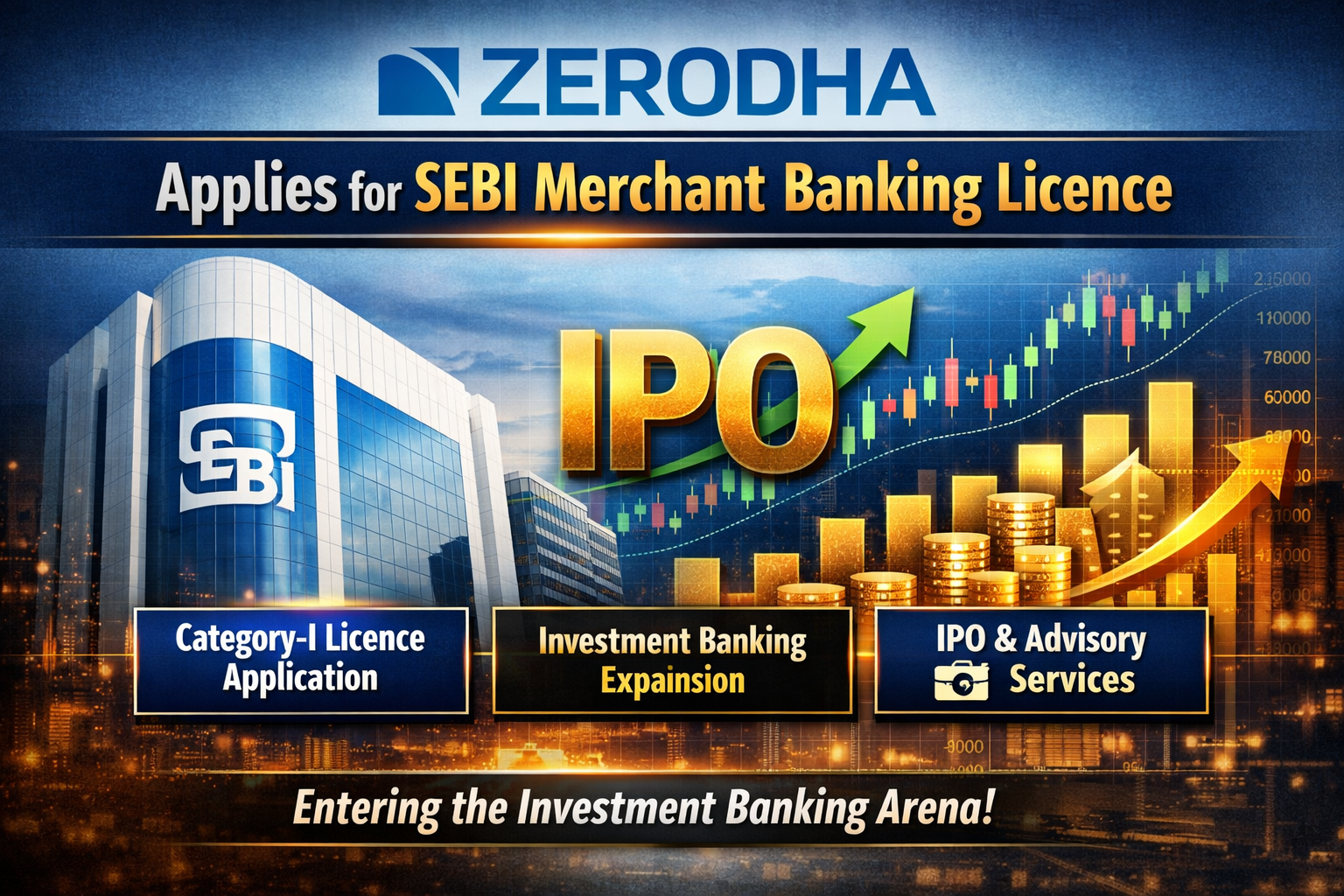
- Comprehensive Full-Stack Capital Ambitions: By securing the necessary Category‑I regulatory approval, the bootstrapped technology firm aims to directly transition from a retail execution layer into a primary market architecture capable of structuring and managing initial public offerings, marking a strategic expansion into Zerodha merchant banking.
- Capitalizing on Public Market Velocities: The calculated corporate expansion arrives amidst an unprecedented structural surge in domestic public listings, positioning the entity to capture lucrative advisory mandates from new-age technology firms and venture-backed enterprises.
- Broader Corporate Diversification Play: Moving intentionally into high-margin advisory frameworks allows the financial network to insulate its overall balance sheet from the cyclical transaction volume drops that frequently impact pure retail brokerage operations.
The financial services landscape across developing markets is witnessing an incredible structural convergence as digital-first retail brokerages aggressively transition into full-scale institutional powerhouses. For over a decade, hyper-scale technology platforms focused almost entirely on democratizing access to secondary market equity trading, building massive user communities through ultra-low execution costs and highly simplified user interfaces. However, as customer acquisition loops mature and retail transaction volumes face natural macroeconomic stabilization cycles, these platforms must seek out fresh industrial frontiers to sustain their financial momentum.
This maturation process has led forward-thinking fintech founders to train their sights directly on the lucrative, relationship-driven world of primary market capital management and structured corporate advisory. Entering the institutional space requires a profound structural pivot away from purely automated algorithmic processing systems and toward sophisticated corporate negotiation and strict regulatory compliance. This unique shift is fundamentally altering the competitive dynamics of the domestic investment landscape, setting up an intense battle between agile, tech-driven retail networks and deeply entrenched legacy banking conglomerates.
A detailed look at the corporate filings confirms that the strategic filing for a Zerodha merchant banking licence represents the platform’s most audacious institutional pivot to date. Filed through a specialized group corporate entity known as Zerodha Corporate Advisors Private Limited, this crucial application is currently undergoing detailed review by the capital market regulator. Obtaining this specific regulatory status will grant the organization the legal authority to underwrite equity issuances, structure complex corporate mergers, and act as a primary manager for fast-growing corporate enterprises eyeing public market liquidity.
By establishing an early, dedicated operational footprint within the highly competitive Zerodha investment banking arena, the Bengaluru-headquartered brokerage platform plans to systematically build out a unified, end-to-end financial ecosystem. For years, the platform functioned primarily as a distribution pipeline, allowing millions of retail participants to subscribe to public offerings structured exclusively by external financial firms. This new institutional strategy flips the traditional relationship entirely, empowering the company to source corporate issuers directly, manage their primary market paperwork, and distribute equity allocations directly to their own massive internal user base.
Disrupting Legacy Institutional Advisory and Underwriting Moats
The operational mechanics behind the Zerodha merchant banking strategy point to a highly calculated effort to deeply democratize how private companies transition into public market assets. Historically, the premium corporate advisory space has been heavily dominated by a closed circle of massive multinational banking institutions and elite domestic financial houses. These traditional organizations rely extensively on highly manual, opaque negotiation networks and heavy institutional sales desks to successfully place corporate shares with large-scale public asset managers.
By introducing a lean, technology-first approach to the Zerodha investment banking division, the platform has a unique opportunity to drastically reduce the steep administrative overhead costs traditionally associated with corporate capital raising. Startups and mid-sized corporate enterprises preparing for a public listing frequently struggle with high underwriting fees and complex coordination layers between multiple intermediary platforms. A digital-first investment bank can leverage cloud architecture to seamlessly automate complex compliance reporting, drastically accelerate draft prospectus creation, and streamline legal due diligence tracking.
Furthermore, this institutional expansion serves as a powerful structural buffer against the visible revenue slowdowns that have impacted the retail stock brokerage sector over the past fiscal cycle. Internal financial indicators show that the company’s operating revenues and net profitability experienced notable normalization trends, settling at approximately 8,847 crore rupees and 4,237 crore rupees respectively. By building out an alternative, non-cyclical revenue stream rooted in long-term corporate advisory mandates, the business can protect its core balance sheet from sudden, unpredictable shifts in retail day-trading activity.
The company’s extensive historical experience in building successful adjacent financial products provides an incredibly strong foundation for this ambitious corporate advisory transition. From pioneering direct mutual fund distribution through their dedicated Coin platform to launching integrated asset management operations and introducing cross-bank fixed deposit features, the group has consistently demonstrated a unique ability to scale complex financial systems. This proven execution capability gives corporate boards immense confidence that the platform can safely handle the high-stakes compliance demands of a public listing.
Enhancing Primary Market Access for Emerging Tech Ecosystems
When analyzing the long-term impact of the Zerodha merchant banking initiative, local capital market experts emphasize the immense value proposition it offers to the domestic startup ecosystem. Over the next few years, hundreds of venture-backed tech platforms and digital consumer brands are expected to mature into viable candidates for public stock exchange listings. These fast-growing digital founders naturally prefer working with modern financial intermediaries who completely understand digital scale, algorithmic data distribution, and modern software-driven business models.
The upcoming launch of the Zerodha investment banking framework will allow the group to position itself as the natural advisory partner for this massive wave of digital-first corporate issuers. Because the brokerage house already maintains an active early-stage investment presence through its highly successful Rainmatter incubation pipeline, it possesses deep, trusted relationships with the next generation of founders. This unique corporate positioning gives them a distinct structural advantage over traditional banks when competing for prestigious mainboard and SME platform listing mandates.
Entrackr
Additionally, the ability to orchestrate a truly democratic public listing process represents a massive competitive advantage that traditional advisory houses simply cannot replicate. When an investment bank manages an IPO, a primary operational challenge is ensuring broad, stable equity distribution across diverse categories of public market participants. By leveraging an internal network of over 1.6 crore verified retail trading accounts, the firm can guarantee corporate issuers immediate, deep retail penetration without relying on expensive external marketing networks or third-party distribution campaigns.
This highly direct, vertically integrated distribution capability has the potential to fundamentally transform how public issue pricing and retail book-building operate in the domestic capital markets. By removing multiple legacy intermediary layers from the IPO syndication process, the platform can pass significant cost savings back to both the capital-seeking corporate boards and the everyday retail buyers. This structural optimization ensures that public market wealth creation becomes far more efficient and equitable for all participants involved in the transaction.
Building a Long-Term Institutional Moat in Indian High Finance
Ultimately, the successful execution of the Zerodha merchant banking strategy will permanently solidify the platform’s status as a comprehensive, full-service financial powerhouse. The ongoing transition out of a highly specialized discount brokerage model into a multi-faceted institutional advisory matrix highlights how rapidly digital wealth systems are maturing across developing economic zones. For established legacy investment banks that have comfortably dominated the primary market advisory space for decades, this digital transformation signals a period of intense margin compression and rapid technological modernization.
As the regulatory bodies meticulously evaluate the pending documentation, the group is quietly assembling the foundational talent pools and specialized risk-compliance frameworks required to run a world-class institutional advisory wing. Winning the ultimate trust of large-scale corporate boards requires maintaining an unyielding commitment to strict regulatory guidelines, absolute transactional security, and sophisticated market timing analytics. By combining their legendary engineering focus with proven financial risk compliance protocols, the organization is uniquely positioned to redefine excellence within the Zerodha investment banking domain.
In conclusion, the bold decision to seek a Category-I SEBI merchant banking licence stands as an incredibly powerful testament to the long-term strategic vision of the platform’s bootstrapped leadership. By building a robust institutional business that perfectly complements their dominant retail stockbroking framework, the company is systematically constructing an enterprise that can thrive across every stage of the market lifecycle. For corporate founders, retail stock market participants, and institutional allocators watching the rapid evolution of the Indian financial architecture, this historic institutional pivot will undoubtedly shape the future of capital raising for a generation.
Visit Augmenting Money for the most recent information.
Leave a Reply