
Highlights
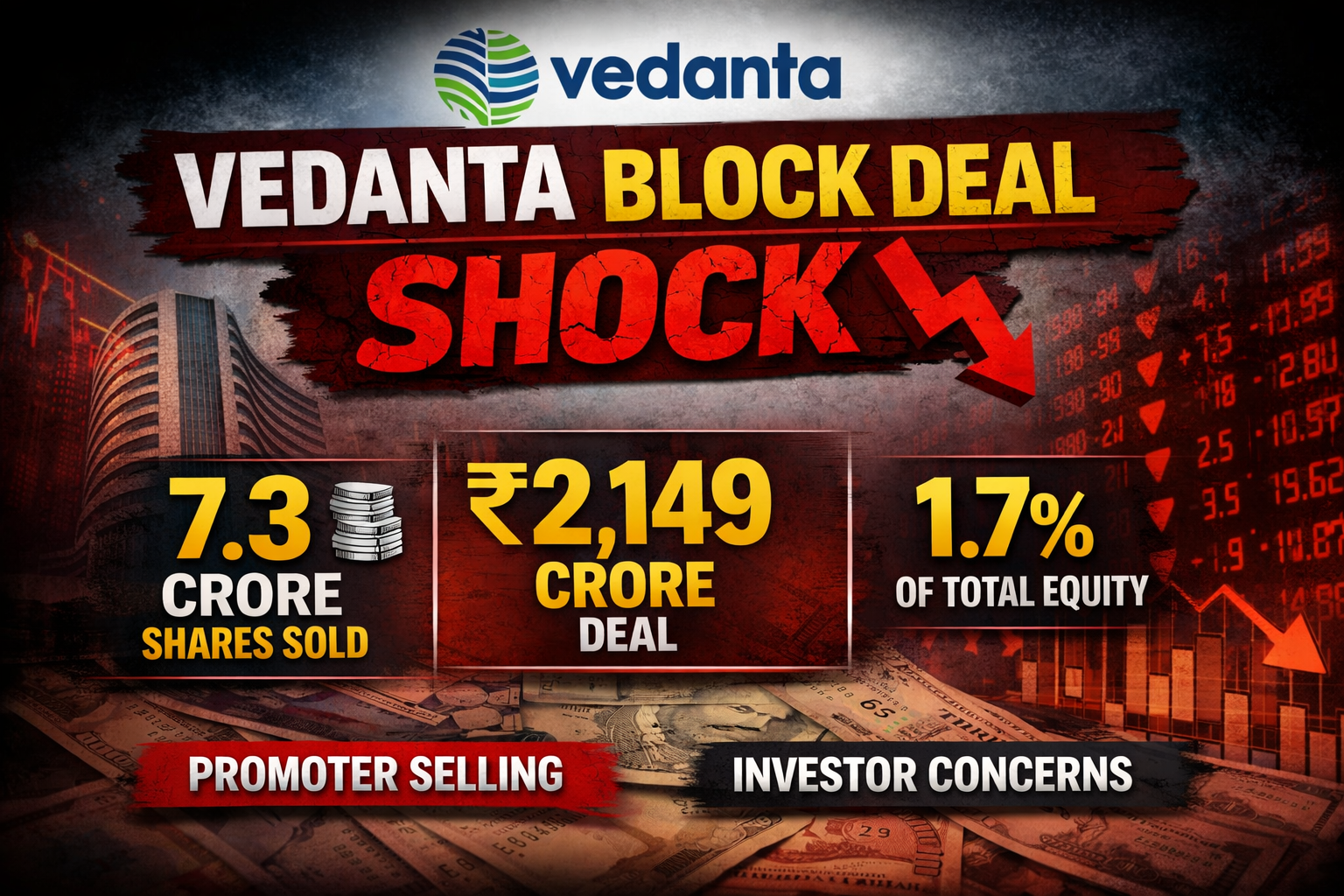
- Massive Equity Exchange: A large‑scale Vedanta block deal executed on the stock exchanges witnessed approximately 7.3 crore shares changing hands, representing about 1.7% to 1.8% of the company’s total outstanding equity.
- Promoter Dilution Fears: The transaction was reportedly initiated by promoter entity Twin Star Holdings at a floor price of ₹292 per share, sparking market anxieties regarding promoter selling risk and ongoing debt obligations at the parent level.
- Immediate Market Impact: Following the deal, the Vedanta share price faced immense selling pressure, plunging over 7% during intraday trading and breaking below crucial short-term moving averages.
The domestic equity market witnessed significant volatility as the Vedanta share price experienced a sharp correction following the execution of a massive institutional transaction. Investors reacted with caution to the news of a ₹2,149 crore Vedanta block deal that took place during the early trading hours.
This massive transaction involved approximately 7.3 crore equity shares changing hands on the exchanges, sparking intense discussion regarding the underlying motives of the sellers and the potential long-term implications for retail and institutional shareholders alike. The sudden influx of sell orders placed immense pressure on the counter, dragging the stock down by more than 7% and triggering a fresh wave of technical breakdown on the daily charts.
Market participants immediately turned their focus toward the source of this heavy liquidation, with multiple reports pointing toward a key promoter entity as the primary seller. The rumor mill and subsequent exchange data indicated that Twin Star Holdings, which is Vedanta’s largest promoter shareholder, likely pared a portion of its equity stake to raise capital.
This massive offloading of shares raised immediate red flags regarding promoter selling risk, a factor that has historically capped the upside potential of the conglomerate due to the high debt burdens managed by the parent entity, Vedanta Resources. As the transaction rolled through the block deal window, the market tried to digest whether this was a one-off restructuring event or the beginning of a larger stake dilution campaign.
The execution of this specific Vedanta block deal comes at a highly critical juncture for the mining and metals major, occurring less than two weeks after the formal completion of its massive corporate demerger. The group recently restructured its business by spinning off its core operating segments including its highly valued aluminum, oil and gas, power, and iron and steel units into independently listed corporate entities on the stock exchanges.
While this structural overhaul was designed to unlock substantial shareholder value and eliminate the traditional conglomerate discount, the sudden promoter stake sale has temporarily overshadowed those long-term strategic objectives. Instead of focusing entirely on the independent earnings potential of the newly listed units, the trading community is once again forced to analyze the immediate financial pressures affecting the parent group’s balance sheet.
Technical analysts observing the intraday price action noted that the sudden drop in the Vedanta share price has severely weakened the stock’s short-term charting structure. Before this sudden sell-off, the counter had been consolidating within a relatively healthy boundary, but the high-volume block trade forced a decisive breakdown below crucial support zones.
By tumbling past the immediate psychological support boundaries, the stock slipped below its 20-day and 50-day exponential moving averages, signaling to momentum traders that the intermediate bias has shifted from bullish to defensive. The relative strength index also plunged sharply toward the oversold territory, validating the intense distribution pattern seen across institutional trading desks during the session.
The broader implications of promoter selling risk continue to act as a significant psychological overhang for the retail investment community. When a primary promoter entity decides to offload equity through a high-volume vehicle like a Vedanta block deal, it often creates apprehension that the group is scrambling to meet impending debt maturities or interest servicing obligations at the overseas holding company level.
Even though domestic institutional brokerages have repeatedly emphasized that such secondary market stake sales do not alter the robust operational fundamentals or the strong cash-flow generation of India’s core manufacturing plants, the near-term sentimental damage is frequently enough to keep value buyers on the sidelines. Investors naturally fear that a persistent supply of shares in the open market will continuously suppress any meaningful price recovery.
From a fundamental standpoint, the underlying performance of the company remains anchored by its low-cost production capabilities, particularly within its core metals and processing divisions. According to recent financial disclosures, the company reported stellar operating profitability and disciplined cost optimization strategies, driven by integration benefits and buoyant commodity price cycles globally.
However, equity markets are highly sensitive to corporate governance dynamics and changes in shareholding patterns, meaning that excellent operational metrics can easily be neutralized by perceived risks at the holding company level. Until the management provides absolute clarity regarding the utilization of the proceeds generated from the Vedanta block deal, the stock may continue to experience heightened volatility.
Looking ahead, institutional investors are closely monitoring the post-demerger index adjustments and the subsequent fund flows that will dictate the trajectory of the Vedanta share price. Following the structural split of the conglomerate, global index providers like MSCI have announced changes to their standard indices, requiring passive funds to realign their portfolios based on the new equity structures of the residual business.
This institutional rebalancing, combined with the sudden overhang from the promoter group’s capital requirements, creates a complex landscape for short-term traders. While some contrarian fund managers view the sharp slide as a compelling buy-the-dip opportunity given the attractive dividend yield history of the group, conservative market participants prefer to wait until the selling pressure subsides completely.
Evaluating Technical Resistance Levels and Capital Reallocation
The structural damage inflicted on the daily candlestick charts indicates that the Vedanta share price will face immediate and stiff resistance if it attempts to stage a near-term recovery. Market experts point out that the floor price of ₹292 per share, which was established during the morning block trade, will now act as a significant overhead supply zone where trapped buyers might look to exit their positions.
Furthermore, the intermediate technical indicators suggest that as long as the counter trades below its key moving averages, the bears will maintain the upper hand, potentially dragging the valuation down toward deeper historical support levels. For a sustained bullish reversal to manifest, the stock must reclaim these technical levels on the back of institutional buying.
Ultimately, the execution of the Vedanta block deal serves as a stark reminder of the dual realities that investors face when dealing with highly leveraged commodity conglomerates. On one hand, the operational businesses are strategically positioned to capitalize on India’s massive infrastructure push, urban transition, and clean energy revolution, all of which demand an uninterrupted supply of primary industrial metals. On the other hand, the persistent promoter selling risk stemming from external financial commitments creates a recurring pattern of equity dilution that challenges long-term capital appreciation.
Navigating this delicate balance will require investors to maintain a disciplined approach, closely monitoring both the operational efficiency of the domestic plants and the macro-level debt reduction milestones achieved by the parent organization.
Leave a Reply