
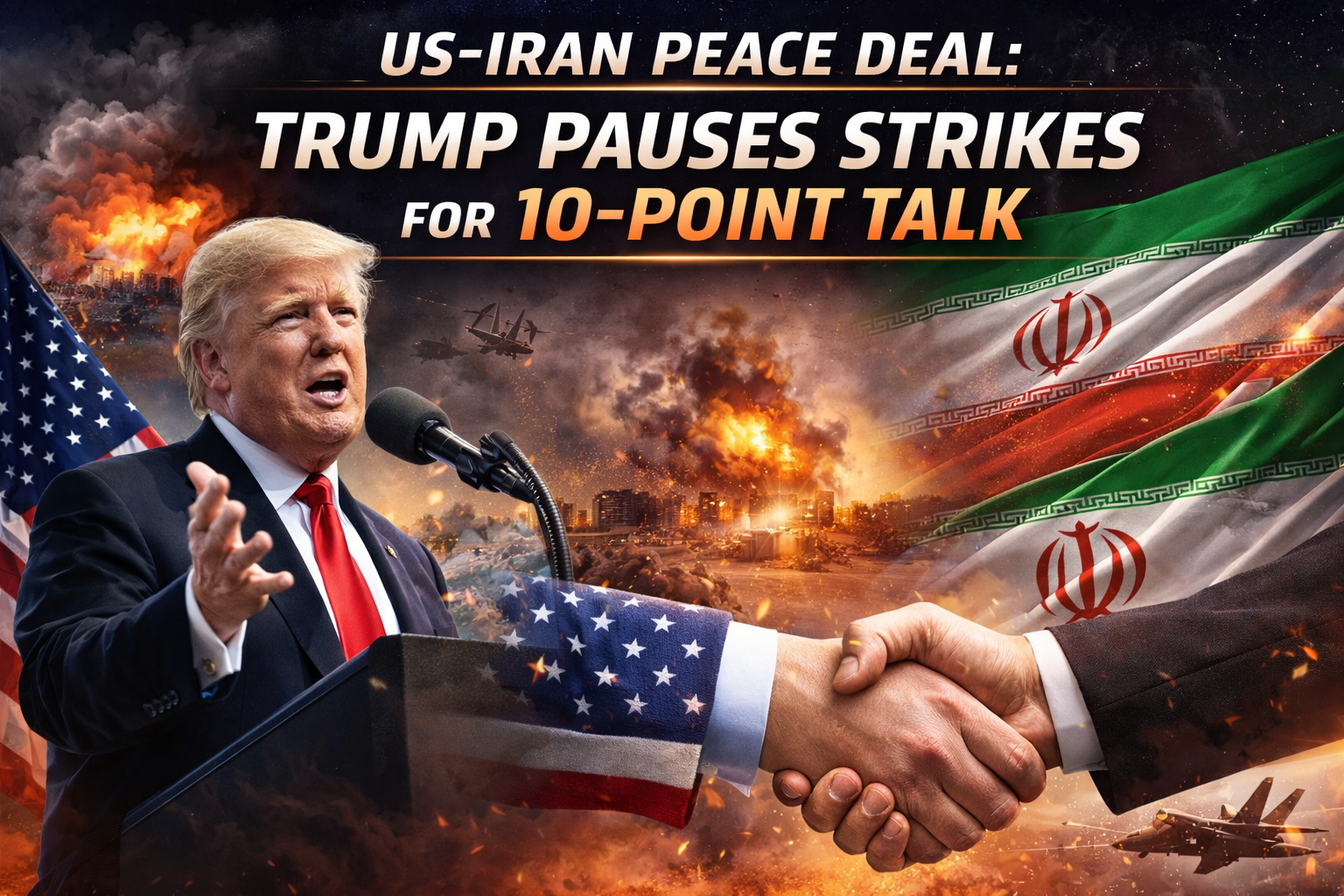
In a dramatic shift that has left the world holding its collective breath, President Donald Trump announced late Tuesday a two-week suspension of planned military strikes against Iran. This de-escalation comes just 90 minutes before a self-imposed deadline that threatened to “wipe out a whole civilization,” signaling a pivot toward what the White House calls a “workable basis” for a US Iran peace deal.
The breakthrough was facilitated by high-stakes mediation from Pakistan, with Prime Minister Shehbaz Sharif and General Asim Munir playing pivotal roles. The pause is contingent on Tehran’s immediate reopening of the Strait of Hormuz a vital maritime artery that carries roughly 20% of the world’s oil supply.
This article breaks down:
- The core components of Iran’s 10-point proposal.
- The immediate impact on global oil prices and stock markets.
- What this diplomatic “breather” means for Indian entrepreneurs and US investors.
- The risks and rewards of the upcoming “Islamabad Talks” scheduled for Friday.
Inside the 10-Point Proposal: The Foundation for Peace
While the full text remains classified, leaks from Tehran and the White House indicate that the 10-point framework addresses decades of frozen conflict as a foundation for a potential US Iran peace deal. President Trump described the document as a “workable basis” for a definitive agreement.
Key Demands from the Iranian Framework:
- Regulated Passage in Hormuz: Iran proposes “regulated passage” under the coordination of its armed forces.
- Total Sanctions Relief: A lifting of all primary and secondary US sanctions.
- Nuclear Recognition: Acceptance of Iran’s uranium enrichment program (a major historical sticking point).
- US Military Withdrawal: The withdrawal of United States combat forces from all bases and points of deployment within the region.
- Reconstruction Compensation: Full payment of compensation to Iran for infrastructure costs.
- Regional De-escalation: Complete cessation of the war in Iraq, Lebanon, and Yemen.
- Asset Release: The release of all Iranian funds and assets frozen by the United States.
- Non-Aggression Pact: A formal US commitment to non-aggression toward the Iranian state.
- Binding Resolution: A UN Security Council resolution to make the deal legally binding under international law.
- Immediate Ceasefire: A halt to all hostilities across all regional fronts.
Market Reaction: A Sigh of Relief for Global Business
The announcement had an immediate and profound effect on global finance. For US investors, the pause represents a shift from “war footing” to “speculative growth.”
- Oil Prices Plunge: Following the announcement, the price of a barrel of oil immediately dropped by 14%, according to Washington Post reports. This is a massive relief for a global economy that had seen gas prices nearly double during the five-week conflict.
- Stock Futures Surge: S&P 500 and Nikkei 225 futures spiked as the threat of an imminent energy crisis receded. In Japan, the Nikkei rose by more than 2,600 yen shortly after the news broke.
- Currency Fluctuations: The Japanese yen weakened against the dollar, settling at approximately 158 yen, as “safe-haven” buying slowed.
“If this two-week ceasefire holds with serious talks, one thing is clear: Regime change is out legitimizing this regime is in.” — Aaron David Miller, Middle East Analyst
Why Indian Entrepreneurs and US Investors Should Pay Attention
The potential for a US Iran peace deal creates a tectonic shift in the geopolitical landscape, particularly for the Indo-Pacific corridor and the American energy sector.
Opportunities for Indian Entrepreneurs
India has historically maintained a delicate balance with Iran, particularly regarding the Chabahar Port project.
- Energy Security: As one of the world’s largest oil importers, a stable Strait of Hormuz is vital for India’s fiscal health.
- Logistics Corridors: A peace deal could revive the International North-South Transport Corridor (INSTC), allowing Indian goods to reach Russia and Europe via Iran more efficiently.
- Tech & Infrastructure: If sanctions are lifted, Indian tech firms and construction conglomerates will find a massive, underserved market in need of modernization.
The Stakes for US Investors
For those in the US, the “Golden Age of the Middle East” (as Trump dubbed it) presents unique entry points.
- Defense vs. Diplomacy: While defense stocks may see a cooling period, global logistics and shipping companies (like Maersk or FedEx) stand to gain from reopened trade routes.
- Energy Diversification: A deal could stabilize global supply chains, allowing US companies to focus on domestic production without the volatility of Middle Eastern “war premiums.”
The Road to Islamabad: Challenges Ahead
Despite the optimism, the path to a permanent US Iran peace deal is fraught with obstacles. Israeli Prime Minister Benjamin Netanyahu has expressed cautious support for the pause but clarified that Israeli operations against Hezbollah in Lebanon will continue independently.
Potential Deal-Breakers:
- The “Technical Limitations”: Iran has stated that passage through the Strait of Hormuz will be possible “via coordination.” The US and its allies may view this as a de facto blockade by another name.
- Uranium Enrichment: Washington’s willingness to accept Iranian enrichment remains a significant hurdle for hawks in the US Congress and the Israeli government.
- Verification: Any deal will require a robust inspection regime that Iran has historically resisted.
Conclusion: A Pivot Toward a New Middle East?
The decision by President Trump to pause Iran strikes is a high-stakes gamble on diplomacy over destruction. By granting a two-week extension, the administration is testing whether a “10-point proposal” can replace 47 years of hostility and potentially lead to a broader US Iran peace deal.
Visit Augmenting Money for the most recent information.
Leave a Reply