
Highlights
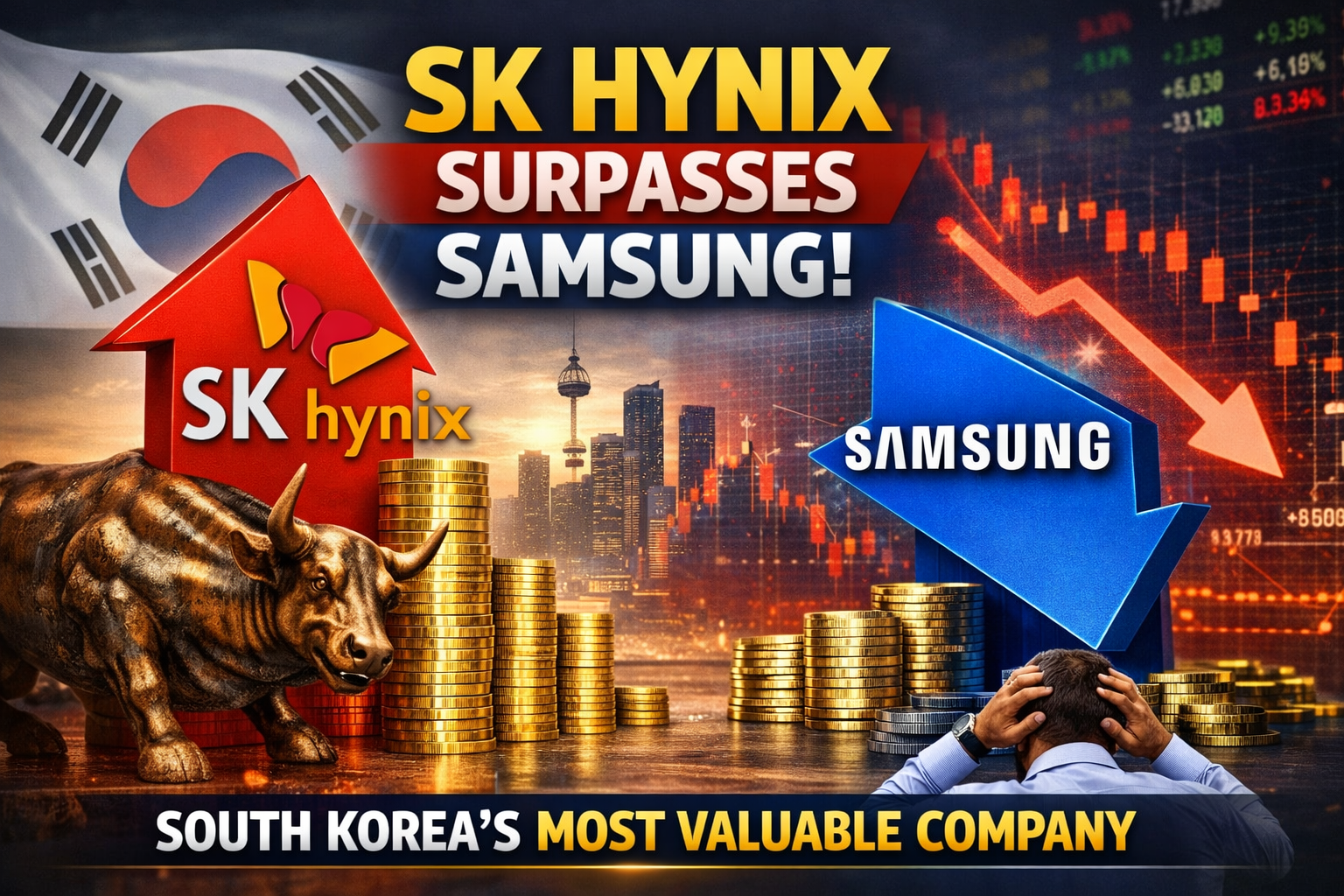
- Historical Leadership Flip: For the first time in over two decades, SK Hynix claimed the top position in KOSPI market capitalization, completely resetting South Korea’s technology landscape and underscoring the surge in SK Hynix market value.
- AI Hardware Domination: The market shift is directly tied to premium high-bandwidth memory supply chains, where a massive first-mover advantage has secured highly exclusive global enterprise contracts.
- Diversification Bottlenecks: Legacy consumer electronics divisions face slower near-term velocity, leaving multi-industry conglomerates vulnerable to targeted semiconductor pure-plays during an artificial intelligence supercycle.
The global semiconductor ecosystem has experienced an unprecedented realignment, marking one of the most significant corporate transformations in modern financial history. For nearly a generation, the undisputed peak of South Korea’s industrial economy was held by a singular, diversified consumer electronics conglomerate. However, recent trading sessions on the Seoul stock exchange have shattered this long-standing hierarchy, as an aggressive, focused memory specialist officially claimed the mantle of the nation’s most valuable listed corporation. This tectonic shift highlights how modern capital allocation heavily favors extreme specialization over legacy macroeconomic conglomerates during periods of rapid structural innovation.
Financial analysts tracking cross-border technology portfolios have observed an intense concentration of institutional capital moving directly into pure-play hardware infrastructure. The historic migration of equity has completely redrawn the baseline expectations for the East Asian hardware supply chain, as trading desks actively reward businesses that demonstrate direct integration into advanced computational frameworks. As the demand for high-performance enterprise architecture continues to accelerate globally, the traditional benchmarks used to calculate sovereign tech leadership are being fundamentally re-evaluated by international fund managers.
The underlying catalyst for this monumental market reorganization is a visible divergence in the forward-looking earnings trajectories of the region’s two primary semiconductor giants. Institutional investors are rapidly driving up the SK Hynix market value to historic heights, reflecting the enterprise’s absolute dominance in specialized memory architectures. Conversely, a noticeable Samsung valuation drop has developed simultaneously across major equity indexes, as public markets express growing impatience with multi-tiered corporate structures that cannot pivot as quickly to capture immediate, high-margin software intelligence hardware pipelines.
Redefining High-Bandwidth Architecture and Portfolio Distribution
To fully comprehend the mechanics of this market disruption, it is essential to look at the underlying hardware architectures that are currently dictating global technology valuations. In previous hardware eras, memory chips were largely treated as standard commodities, subject to brutal, highly predictable cyclical pricing drops that frequently wiped out corporate operating margins. The modern computing landscape, however, has completely upended this dynamic by turning specialized storage systems into critical, custom-designed performance enablers that determine the processing ceilings of the world’s most advanced deep-learning accelerators.
By recognizing this technological shift ahead of its domestic and international peers, the newly crowned market leader executed a multi-year, high-risk capital investment strategy focused on high-bandwidth memory arrays. This deliberate focus allowed the organization to secure an essential first-mover advantage, capturing an estimated majority of the premium storage layer market utilized in next-generation data infrastructure. The financial reward for this operational foresight has been nothing short of extraordinary, with recent quarterly reports displaying astronomical revenue surges and operating margins that rival the world’s most profitable fabless design houses.
As these record-breaking fiscal results validate the company’s aggressive technological roadmap, investor enthusiasm has reached a fever pitch, further supported by strategic international initiatives. Management’s recent decision to pursue an American Depositary Receipts listing on major United States stock exchanges has provided a massive boost to the rising SK Hynix market value. This planned cross-border listing opens up direct channels to a vast pool of global institutional capital, allowing the enterprise to benchmark its valuation multiples directly against premium Western hardware peers rather than remaining confined to localized domestic indexes.
In stark contrast, the factors contributing to the concurrent Samsung valuation drop stem primarily from the inherent friction of managing an immense, highly diversified global product portfolio. While operating massive divisions dedicated to consumer smartphones, home appliances, display panels, and contract foundry services provides excellent structural stability during standard economic downturns, it simultaneously acts as a drag during a highly concentrated technology boom. The massive capital reserves required to subsidize these various consumer-facing units have inadvertently diluted the organization’s ability to achieve absolute dominance in the hyper-specialized high-bandwidth memory race.
Furthermore, public equity markets are executing strict corrections on firms that experience unexpected yield delays or validation bottlenecks within their primary cutting-edge production lines. As premier global design firms and enterprise cloud providers enforce uncompromising quality standards for their processing architectures, any delay in achieving high-volume manufacturing approval translates directly into lost market share. This demanding operational climate has forced aggressive institutional portfolio reallocations, penalizing legacy diversification and redirecting capital toward the agile pure-play manufacturer that currently holds the dominant supplier status for global computing platforms.
The competitive landscape is further complicated by shifting regional dynamics and evolving international trade regulations that require immense operational flexibility. Maintaining massive, highly sophisticated manufacturing hubs across multiple overseas jurisdictions introduces complex geopolitical variables that can threaten long-term supply chain consistency. In this highly sensitive environment, the enterprise that maintains streamlined, highly transparent corporate governance and highly concentrated product lines can reassure global buyers far more effectively, stabilizing its forward revenue projections even as broader macroeconomic crosscurrents create localized industry volatility.
Long-Term Supply Ecosystems and Sovereign Technology Clusters
Looking ahead across a multi-year horizon, the structural transformation of the East Asian technology cluster is expected to deepen as sovereign governments intervene to protect their core industrial assets. Recognizing that semiconductor self-sufficiency and hardware design dominance are now core pillars of long-term economic security, policymakers are actively coordinating with top-tier corporate leadership to accelerate infrastructure expansion. Planned multi-billion-dollar investments aimed at establishing mega-scale domestic manufacturing clusters demonstrate a shared determination to anchor the region as the absolute nexus of global computational production through the next decade.
However, the nature of corporate competition within this sovereign cluster has changed permanently, moving away from simple volume-based market-share battles to a ruthless race for absolute technical supremacy. The traditional assumption that a secondary market runner-up can never permanently overtake an entrenched, capital-heavy industry pioneer has been thoroughly disproven by the recent realignment of the KOSPI index. This historic shift serves as a powerful reminder to the global financial community that in eras of profound technological disruption, operational agility and focused intellectual property creation will consistently outperform raw corporate scale.
For institutional asset managers, navigating this new era of tech leadership requires moving past historic brand loyalty to rigorously analyze real-time supply chain relationships. While the dramatic Samsung valuation drop reflects a temporary loss of momentum in the high-stakes memory segment, the absolute scale and engineering depth of the technology giant mean that a fierce counter-offensive is already underway. As both domestic titans deploy massive tranches of capital to master upcoming manufacturing iterations, the resulting technological race will likely push the entire South Korean semiconductor ecosystem to unprecedented levels of global influence.
Ultimately, the sustainability of the newly elevated SK Hynix market value will depend entirely on its capacity to defend its crucial first-mover advantage against aggressive competitive pressures. As long-term supply agreements expand and the global implementation of advanced artificial intelligence systems transitions from speculative enterprise testing to mainstream industrial deployment, the demand for highly specialized, ultra-fast memory components will remain resilient. For global investors monitoring the core infrastructure of the modern digital economy, this historic shift in South Korean market leadership represents the opening chapter of a fundamentally reorganized global technology landscape.
Visit Augmenting Money for the most recent information.
Leave a Reply