
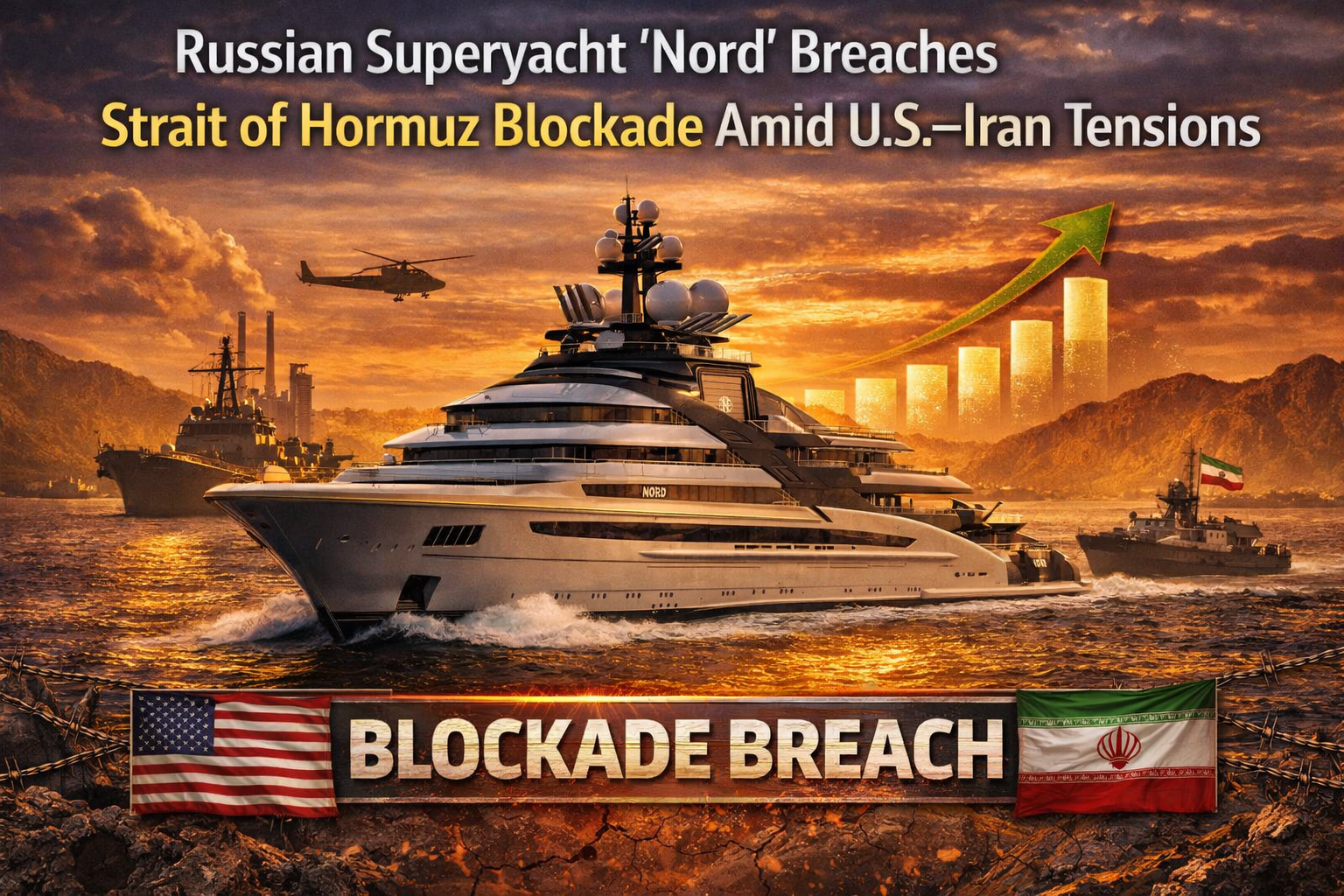
In a world where geopolitical tension often dictates the flow of global trade, a single vessel has recently captured the attention of maritime monitors and international diplomats alike. Amidst a high-stakes standoff between the United States and Iran, the Russian superyacht Nord a 142-meter marvel of luxury and engineering successfully transited the blockaded Strait of Hormuz this past weekend.
The transit occurs at a critical juncture. Since February 28, 2026, the Strait of Hormuz, which typically handles 20% of the world’s oil supply, has seen traffic plummet by 95% due to an Iranian-led blockade and subsequent U.S. naval countermeasures. While thousands of commercial vessels remain anchored in uncertainty, the Nord’s passage raises profound questions about the “special status” afforded to Russian assets and the shifting alliances defining the current conflict.
Strategic Significance: Why the Nord’s Transit Matters
The Alexey Mordashov yacht, worth an estimated $500 million, left Dubai on Friday and arrived in Muscat, Oman, by Sunday morning. In an era where even essential merchant ships are avoiding the waterway due to prohibitive insurance costs and the threat of drone strikes, the Nord’s unscathed and flamboyant crossing is a significant geopolitical signal.
Russia-Iran Alliance in Action
The passage is widely seen as a tangible outcome of the 2025 Intelligence and Security Cooperation Treaty signed between Moscow and Tehran. While the Strait is effectively closed to hostile Western nations, Russia and Iran have strengthened their bilateral ties, with Iranian Foreign Minister Abbas Araqchi arriving in Moscow just 48 hours after the Nord cleared the Strait.
Testing the “U.S. Counter-Blockade”
The U.S. has imposed its own blockade on Iranian ports as a retaliatory measure. However, the Nord’s ability to navigate these waters suggests that certain vessels specifically those flagged by or linked to key Russian interests are operating under a different set of rules. This creates a multi-tier maritime environment that complicates U.S. efforts to enforce a uniform blockade.
Behind the Luxury: Specs of the Nord and its Owner
The Russian superyacht Nord is not just a boat; it is a floating fortress. Built by the German shipyard Lürssen, the vessel is designed for long-range, high-security travel.
- Estimated Value: Over $500 million.
- Key Features: 20 luxury staterooms, two helipads, a swimming pool, and a private submarine.
- Ownership Context: The vessel is linked to Alexey Mordashov, the primary owner of Russian steelmaker Severstal. Mordashov, currently one of Russia’s wealthiest individuals with an estimated fortune of $37 billion, has been under Western sanctions since early 2022.
Despite these sanctions, the Nord has spent the last year navigating international waters, often finding safe harbor in jurisdictions that do not enforce U.S. or EU penalties. Its recent transit from Dubai to Muscat underscores the limitations of Western financial restrictions in a fragmented global economy.
Market Impacts: Energy and Shipping Volatility
The closure of the Strait of Hormuz has sent shockwaves through global markets, particularly impacting energy-intensive economies like India and the manufacturing hubs of Europe.
The “Hormuz Premium”
Since the conflict began on February 28, global oil prices have seen a sustained surge. With daily passages through the Strait dropping from an average of 140 to fewer than 5, the Hormuz Premium has added roughly $15-$20 per barrel to Brent Crude prices.
Shipping Realities in 2026:
- Merchant Stagnation: Only a handful of Chinese, Iraqi, and Pakistani vessels have successfully negotiated diplomatic passage with Tehran.
- Insurance Costs: For non-exempt vessels, war-risk insurance premiums have reached record highs, making the route economically unviable for most commercial carriers.
- Alternative Routes: Companies are paying millions in additional fees to reroute cargo through the Panama and Suez canals or utilizing overland routes through Saudi Arabia, though these cannot replace the volume of the Strait.
Expert Perspective: The New Maritime Diplomacy
Analysts suggest that the Nord’s passage is a calculated move to demonstrate Russian influence in the Middle East.
The Nord isn’t just carrying a billionaire; it’s carrying a message, says a maritime analyst at the House of Commons Library. By allowing this vessel through, Iran is signaling to the world that its ‘blockade’ is selective and diplomatically managed, rather than a total maritime shutdown.
Conclusion
The successful transit of the Russian superyacht Nord through the blockaded Strait of Hormuz is a stark reminder of the complexities of modern warfare and diplomacy. While the U.S. and Iran remain locked in a tense standoff, the movement of high-value Russian assets highlights a growing geopolitical bloc that is increasingly insulated from Western pressure.
Visit Augmenting Money for the most recent information.
Leave a Reply