
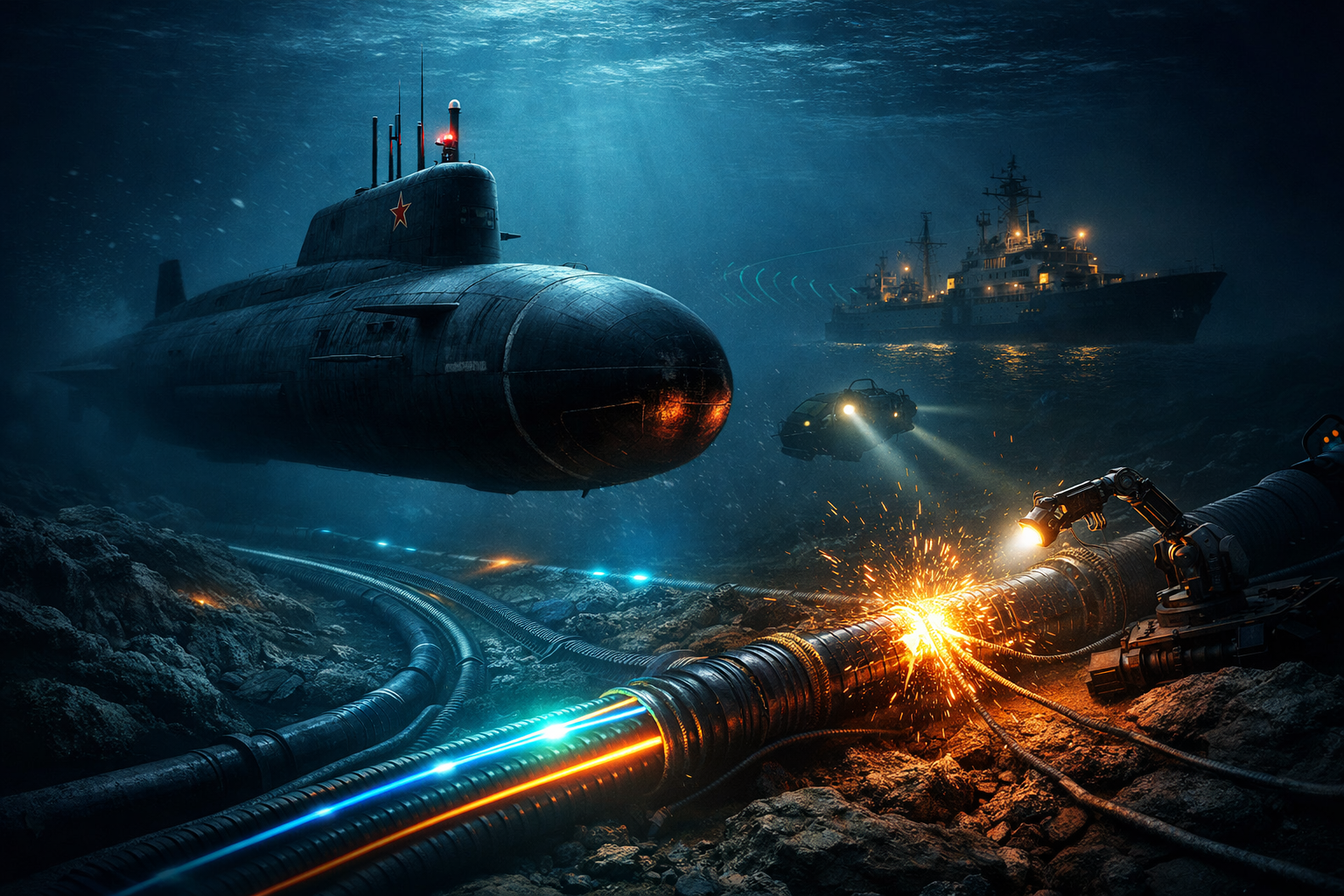
In an era where geopolitical tensions often play out on the evening news, the most significant threat to the global economy may be lurking thousands of feet below the ocean’s surface. In April 2026, the British Ministry of Defence (MoD) officially exposed a month-long, covert Russian submarine operation targeting the delicate web of undersea cables and pipelines that connect the UK to the rest of the world.
This is not just a regional dispute; it is a direct challenge to the “circulatory system” of the global digital economy. With over 99% of international data and trillions of dollars in daily financial transactions flowing through these literal threads of glass and light, the stakes for global investors, entrepreneurs, and governments have never been higher.
This article explores the specifics of the recent UK defence alert Russia triggered, the technical capabilities of the vessels involved, and what this means for global market stability and infrastructure security.
Inside the Operation: What Happened?
On April 9, 2026, UK Defence Secretary John Healey revealed that British forces, in coordination with Norwegian allies, had successfully tracked and deterred a sophisticated Russian naval group. The operation, which lasted over 30 days, involved a “distraction and strike” formation designed to test NATO’s response times and proximity to critical infrastructure.
The Vessels Involved
The Russian submarine operation was not a standard patrol. It featured a high-tech combination of “hunter” and “research” vessels:
- Akula-class Attack Submarine: A nuclear-powered vessel used as a tactical “distraction” to draw the attention of NATO surface ships.
- GUGI Submarines: Specialist craft from the Main Directorate of Deep-Sea Research (GUGI). These are “spy” submarines capable of operating at extreme depths to manipulate or tap into undersea cables.
- Yantar-class Vessels: Often described as “research ships,” these are equipped with autonomous underwater vehicles (AUVs) capable of cutting or damaging infrastructure.
The UK and NATO Response
The UK response was a massive show of force involving over 500 personnel. The Royal Navy deployed the Type 23 frigate HMS St Albans and RFA Tidespring, supported by RAF P8 Poseidon submarine-hunting aircraft. By dropping sonobuoys and maintaining 24/7 surveillance, the UK sent a clear message to Moscow: We see you.
Why the Seabed is the New Frontline
For the global business community, the seabed is no longer just a geographical feature; it is a critical asset class. The recent Russian activity highlights three primary vulnerabilities:
1. The Financial “Snap” to a Halt
Undersea cables handle more than $10 trillion in economic activity annually. Experts from the International Cable Protection Committee (ICPC) estimate that the financial impact of a major cable disruption exceeds $1.5 million per hour for operators alone. For the banking sector, a total outage would not cause a gradual slowdown it would cause the system to “snap” to a halt.
2. Energy Sovereignty
The UK and Europe are increasingly dependent on subsea interconnectors for energy security. These cables link UK power grids to wind farms in the Netherlands and Belgium. Any “malign activity” linked to the Russian submarine operation could theoretically disconnect millions of homes from their energy sources, directly impacting household bills and industrial productivity.
3. Data and Communications
The filaments carrying data within these cables are roughly the diameter of a human hair. Despite their fragility, they support the operations of tech giants like Google, Microsoft, and Meta. A coordinated “darkening” of these lines would paralyze global supply chains and cloud-based services.
Expert Perspective: “The Primary Threat”
“We see your activity over our cables and our pipelines, and you should know that any attempt to damage them will not be tolerated and will have serious consequences.”
— John Healey, UK Defence Secretary (April 2026)
Admiral Sir Tony Radakin, Chief of the Defence Staff, has previously warned that Russia has “grown its capability to put at risk those undersea cables and potentially exploit them.” The 2026 operation confirms that Moscow is no longer just theorizing about “hybrid warfare”—it is actively rehearsing it.
The Strategic Shift: “Atlantic Bastion”
In response to the escalating threat, the UK government has announced the Atlantic Bastion programme. This initiative aims to:
- Invest £100 million in additional P8 submarine-hunting aircraft.
- Develop Autonomous Systems: Utilizing uncrewed underwater vehicles (UUVs) to patrol cable routes 24/7.
- Strengthen Alliances: Deepening the “Lunna House Agreement” with Norway to create a unified northern defense shield.
A Survival Guide for Global Investors and Tech Entrepreneurs
- Infrastructure Resilience: Companies must assess their reliance on single-route data paths. Diversifying cloud providers across different geographic cable landings is now a security necessity.
- Cyber-Physical Convergence: The threat to cables is a physical act with cyber consequences. Security budgets should reflect this overlap.
- Geopolitical Risk Premium: Investors should factor in the “seabed risk” when evaluating European energy and tech stocks.
- Market Growth: The undersea cabling market is projected to reach $26.1 billion by 2026, growing at a CAGR of 12.5%. This presents significant opportunities for firms specializing in subsea repair, autonomous monitoring, and cable armoring.
Conclusion
The recent Russian submarine operation near the UK is a wake-up call for the global community. While the immediate threat was neutralized by the Royal Navy and its allies, the intent remains clear: the seabed is a viable target for hybrid aggression, as highlighted by the UK Defence Ministry. For global businesses and the public alike, protecting this “invisible infrastructure is now as vital as defending national borders
Visit Augmenting Money for the most recent information.
Leave a Reply