
Highlights
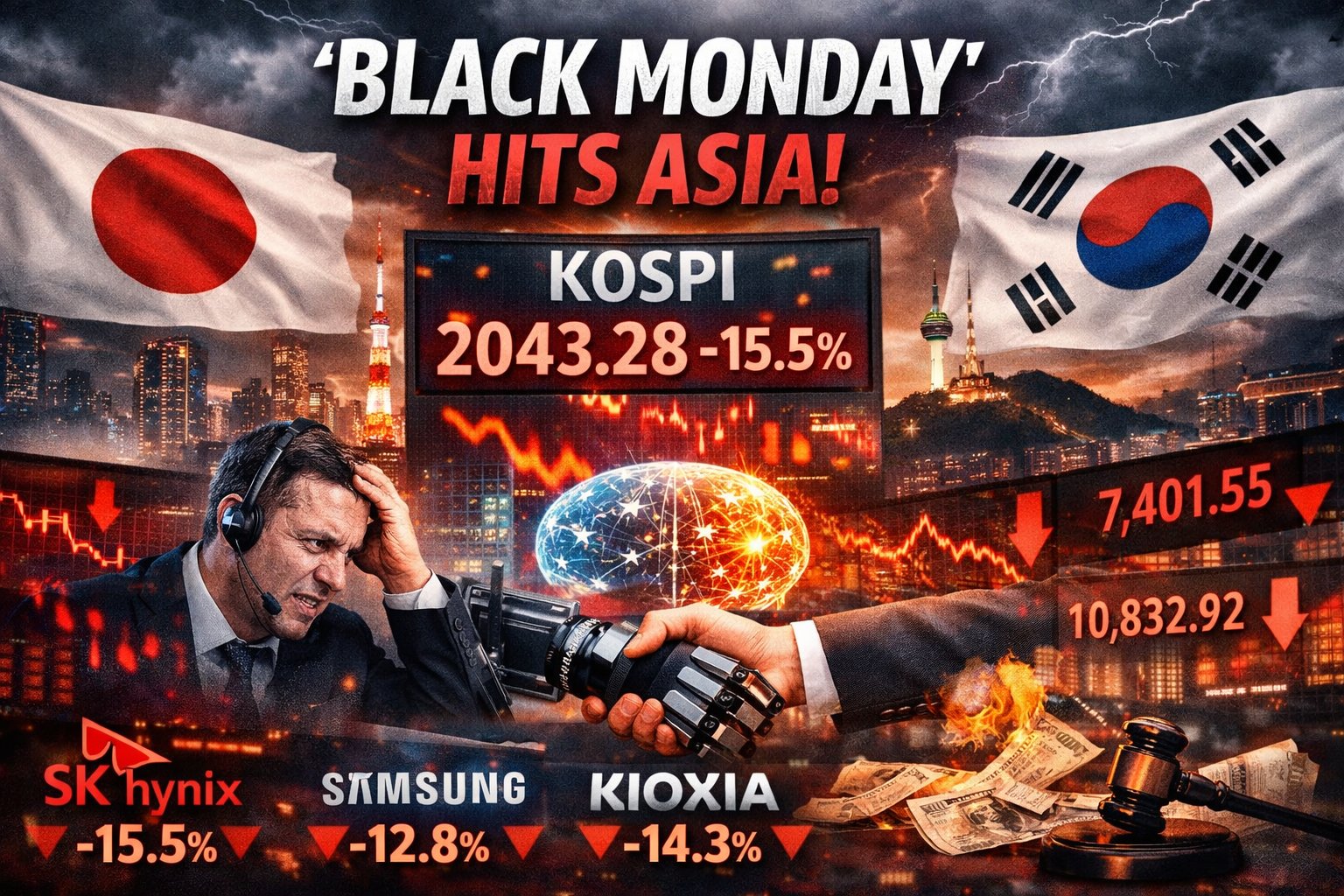
Historic Trading Halt: The activation of a level 1 Kospi circuit breaker forced a complete 20-minute halt across the South Korean stock exchange after the benchmark index rapidly fell past the critical 8% threshold.
Semiconductor Bloodbath: Major global technology hardware leaders suffered extreme capital destruction, with SK Hynix plummeting more than 13% and Samsung Electronics sliding roughly 9% in a matter of hours.
Geopolitical Catalyst: The severe panic selling throughout the Black Monday Asia markets was heavily intensified by escalating military tensions between the United States and Iran, alongside threats to shut down the strategic Strait of Hormuz.
The global financial system experienced a profound structural shockwave as a wave of intense panic selling systematically ripped through international equity centers. What began as a cautious opening bell quickly deteriorated into an absolute rout as institutional portfolio managers rushed to liquidate risk assets across the continent. This synchronized withdrawal of global capital left domestic equity indices exposed to massive downward momentum, setting off a chain reaction across interconnected derivative platforms. By the time morning trading sessions concluded, trillions of won in market capitalization had completely evaporated from the balance sheets of major corporations.
This sudden and extreme decompression in equity valuations highlights the deep vulnerabilities present within modern, highly concentrated electronic trading structures. For over a year, international capital allocators had piled aggressively into Asian electronics manufacturing hubs, inflating corporate valuations to historic heights on the back of artificial intelligence infrastructure spending. However, when multiple macroeconomic and geopolitical risks converged simultaneously, this concentrated positioning rapidly unraveled. The sheer speed of the downturn exposed a complete lack of deep buy-side liquidity, turning a standard market correction into a historic financial emergency.
A detailed review of the day’s market mechanics reveals that the activation of the Kospi circuit breaker represented the definitive moment of peak systemic stress for regional investors. As the South Korean benchmark index fell through its psychological support levels, automated program trading algorithms unleashed an uncontrollable flood of sell orders. This massive wave of liquidation quickly overwhelmed the exchange’s matching engines, forcing the regulatory authorities at the Korea Exchange to deploy their ultimate defensive tool. The temporary market-wide freeze was enacted to give panicked market participants a brief window to reassess the chaotic macro environment.
The terrifying speed of this downward spiral has firmly cemented this trading session into the history books as a true iteration of the infamous Black Monday Asia markets phenomenon. Across the entire Asian region, benchmark indices collapsed in lockstep as regional safe-haven currencies experienced violent price fluctuations against the United States dollar. From Tokyo to Taipei, institutional equity desks reported an absolute breakdown in standard market-making operations, leaving retail participants completely stranded without access to orderly exit pricing. The resulting capital flight illustrates just how quickly localized geopolitical anxiety can transform into a full-blown global margin call.
Anatomy of an Unprecedented Tech and Macro Liquidation
The specific microstructural triggers that forced the regulatory deployment of the Kospi circuit breaker offer an important lesson in the dangers of excessive market concentration. The South Korean equity index has long been heavily weighted toward a small handful of mega-cap semiconductor producers that essentially dictate the direction of the entire domestic economy. When global sentiment regarding hardware earnings capability turns sour, these specific structural weightings ensure that the broader market has zero ability to diversify its downside risk. The resulting sell-off acts as an absolute wrecking ball to the underlying financial infrastructure.
The catastrophic destruction of corporate value was led primarily by the world’s most prominent memory-chip manufacturers, which faced an absolute wall of institutional selling. Shares of SK Hynix, a vital component in the global high-bandwidth memory supply chain, experienced an unprecedented intraday collapse, tumbling more than 13% during a single continuous trading session. This historic plunge occurred despite the company’s highly publicized and successful listing of American Depositary Receipts on the American NASDAQ index just days prior, proving that even major global milestones cannot withstand a structural macro panic.
Simultaneously, the country’s largest corporate entity, Samsung Electronics, faced a wave of indiscriminate dumping that pushed its stock down nearly 9% to around 260,000 won. This massive capitulation reflects deep, growing anxiety among global fund managers regarding whether corporate profitability can actually keep pace with the massive capital expenditures required to build next-generation artificial intelligence networks. As preliminary corporate guidance failed to completely reassure a highly skeptical market, investors chose to aggressively protect their principal capital, liquidating entire equity blocks without any regard for long-term fundamental asset values.
The severe panic selling that defined the Black Monday Asia markets was further exacerbated by a massive unwinding of highly complex, leveraged financial instruments. Over the preceding months, retail and institutional participants had heavily adopted single-stock leveraged exchange-traded funds designed to double or triple daily returns on top-tier technology assets. When the underlying tech stocks began to drop, these volatile instruments triggered automated forced liquidations across thousands of brokerage accounts. This cascading wave of margin calls created an absolute loop of downward pressure, forcing forced selling that dragged down entirely healthy, unrelated sectors of the economy.
The broader international macro environment provided the ultimate spark that ignited this massive financial wildfire. As trading desks processed alarming reports of escalating military friction between the United States, Israel, and Iran, global risk tolerance instantly evaporated. The official declaration from Tehran threatening a complete maritime blockade of the strategic Strait of Hormuz sent absolute shockwaves through international energy and supply chain desks. Faced with the immediate prospect of a massive global energy disruption and an accelerated economic slowdown, international asset managers immediately hit the sell button on risk-sensitive Asian export economies.
This multi-layered crisis quickly spilled over into neighboring jurisdictions, severely damaging investor sentiment across every major regional financial capital. Japan’s benchmark Nikkei 225 index plummeted roughly 2.5%, driven lower as global macro funds rapidly unwound highly sensitive currency carry trades. In Taiwan, the electronics-heavy benchmark index faced intense pressure as global technology bellwether Taiwan Semiconductor Manufacturing Company slipped more than 2%. This synchronized, multi-market collapse demonstrates the tight integration of the modern global electronics supply chain, where an operational shock in one region immediately impacts assets across the entire geographic landscape.
In the immediate aftermath of the Kospi circuit breaker activation, domestic financial authorities and central bank officials scrambled to arrange emergency stabilization meetings. The country’s Ministry of Finance immediately placed its market monitoring desks on an absolute 24-hour high alert, promising to deploy massive public stabilization funds if the currency and equity volatility continued to threaten broader economic stability. However, with individual retail investors rapidly running out of disposable capital and the National Pension Service actively reducing its domestic equity allocations to meet structural rebalancing targets, the market’s traditional backstops appeared visibly weakened.
As the trading day drew to a close, the benchmark index managed a tiny bounce off its absolute intraday lows but still finished the session down a brutal 8.95% at 6,806.93. This devastating close below the psychologically vital 7,000-point threshold leaves the domestic capital market in an incredibly vulnerable technical position heading into the remaining quarters of the fiscal year. With corporate earnings momentum facing a visible seasonal peak and international monetary policy remaining highly restrictive, the road to absolute recovery for the regional financial system looks increasingly long and fraught with structural peril.
Ultimately, the historic deployment of the Kospi circuit breaker serves as a stark, modern warning about the systemic risks embedded within the global technology trade. The dramatic events that characterized this iteration of the Black Monday Asia markets have clearly demonstrated that stellar corporate earnings mean very little when positioning becomes overcrowded and geopolitical realities shift. For global asset allocators, retail day traders, and corporate boardrooms monitoring the rapid restructuring of international capital, this unforgettable session will undoubtedly alter risk-management playbooks and investment strategies for years to come.
Visit Augmenting Money for the most recent information.
Leave a Reply