
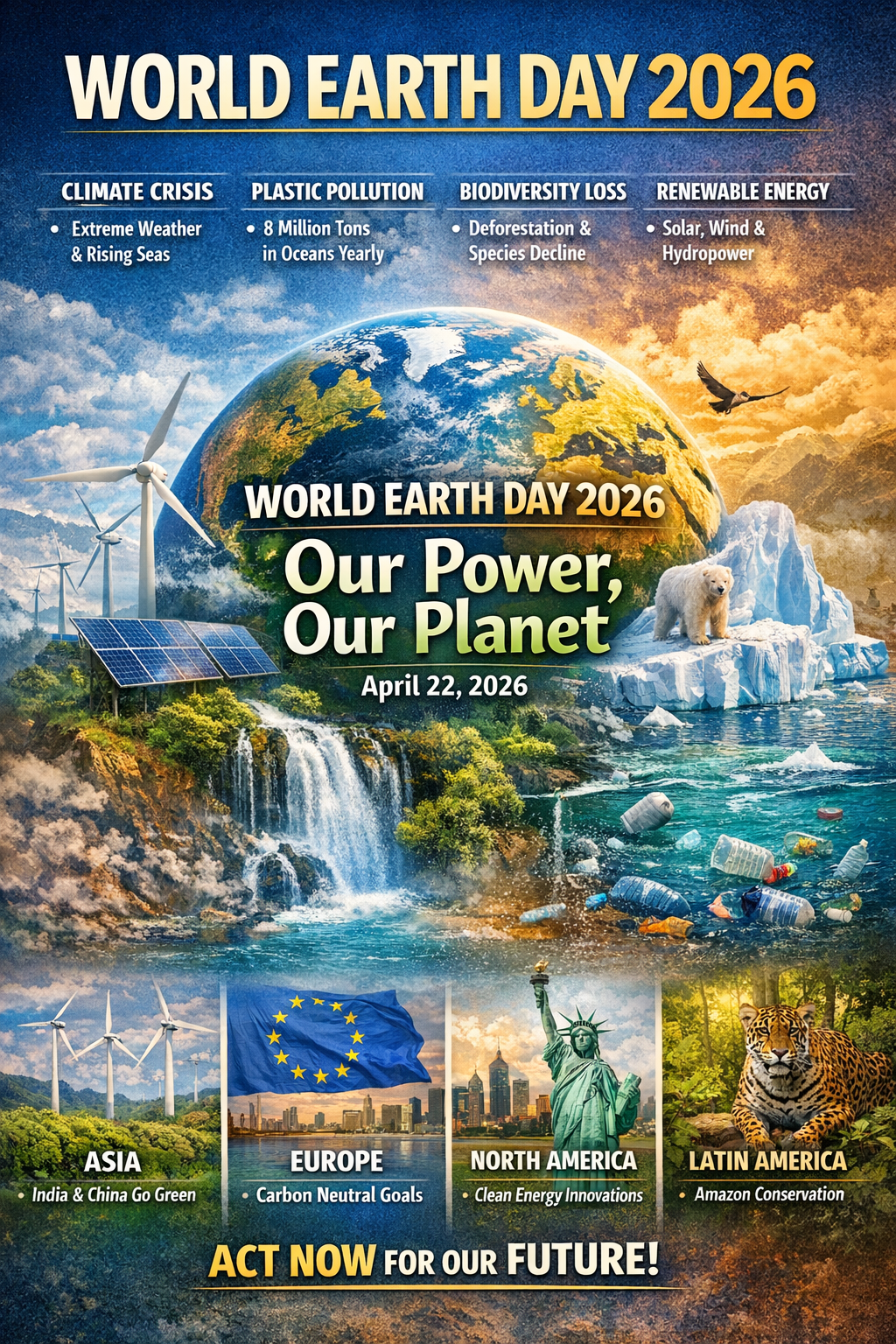
Every year on April 22, the world holds its breath not from despair, but from determination. World Earth Day 2026 arrives at one of the most pivotal moments in environmental history. With climate records shattering year after year, biodiversity disappearing at alarming rates, and extreme weather events rewriting the geography of human life, the 56th edition of Earth Day carries more urgency and weight than almost any before it.
This year’s theme “Our Power, Our Planet” is not a rallying cry born from optimism alone. It is a demand. A declaration that collective human will, when channelled through communities, institutions, and individuals, is the most powerful force on Earth. On April 22, 2026, one billion people across 193 countries will participate in cleanups, marches, teach-ins, tree-planting drives, and advocacy campaigns together forming the largest civic environmental movement in human history.
This article explores the full story of World Earth Day 2026 its date, theme, remarkable history, and its profound global significance at a time when the planet’s future genuinely hangs in the balance.
World Earth Day 2026: The Date
World Earth Day 2026 is observed on Wednesday, April 22, 2026. The date April 22 is no accident. It was deliberately chosen by U.S. Senator Gaylord Nelson and young activist Denis Hayes in 1970 to fall between Spring Break and Final Exams a strategic window designed to maximise student participation. More than five decades later, April 22 has become one of the most recognisable dates in the global environmental calendar.
Unlike most observances that are ceremonial, Earth Day on April 22 functions as a global activation point a moment when environmental campaigns, legislative pushes, community events, and media conversations converge simultaneously across every time zone on the planet. Today, Denis Hayes serves as Board Chair Emeritus of EARTHDAY.ORG, the non-profit that grew from that very first teach-in and now coordinates this annual mobilisation of humanity.
World Earth Day 2026 Theme: “Our Power, Our Planet”
“Our Power, Our Planet”
Mobilising people, communities, and governments to triple global renewable energy production by 2030 because the power to save the Earth belongs to all of us.
The 2026 Earth Day theme speaks with remarkable directness. At its heart, “Our Power, Our Planet” sends a dual message: first, that the power source fuelling our civilisation must urgently transition from fossil fuels to clean, renewable energy; and second, that ordinary people not politicians, not corporations alone hold the greatest power of all: the power of collective action.
This theme calls on individuals, communities, and governments to triple the global production of renewable energy by 2030. It recognises that solar, wind, and clean energy are no longer fringe technologies they are economic powerhouses and the most viable path to addressing the climate crisis. The 2026 theme also affirms something critical: that environmental progress is real, ongoing, and resilient, even amid political uncertainty and policy reversals.
What “Our Power, Our Planet” Represents?
- Renewable Energy Acceleration: A call to triple clean energy production globally by 2030, reducing the world’s dependence on coal, oil, and gas that are driving the climate crisis.
- Community-Led Action: Affirming that cities, schools, Tribal nations, and neighbourhoods implementing local environmental solutions are the backbone of global progress.
- People Over Policy: Environmental progress is sustained by the daily choices of educators, workers, and families not dependent on a single election or administration.
- Accountability: Increased demands on governments and industries to take responsibility for environmental damage and invest in ecological restoration.
- Global Solidarity: Encouraging worldwide collaboration among governments, industries, and citizens to achieve long-term ecological balance and sustainability.
The History of World Earth Day: From 1970 to 2026
To understand why World Earth Day 2026 matters so profoundly, one must travel back more than half a century to a watershed moment in American and global environmental consciousness.
In January 1969, a massive oil well blowout off the coast of Santa Barbara, California, released over three million gallons of crude oil into the Pacific Ocean. Images of oil-soaked seabirds and blackened coastlines shocked a nation. U.S. Senator Gaylord Nelson, already alarmed by the degrading state of America’s environment, decided that what the nation needed was the same kind of passionate, large-scale public activism that was driving the anti-Vietnam War movement.
- 1970 The First Earth Day: On April 22, 1970, approximately 20 million Americans 10% of the U.S. population at the time poured into the streets, parks, and auditoriums to demand action on environmental issues. It was the largest civic demonstration in U.S. history at that point.
- 1970s Legislative Tsunami: Energised by Earth Day, the U.S. Congress passed landmark legislation including the Clean Air Act, the Clean Water Act, and the Endangered Species Act. The Environmental Protection Agency (EPA) was established in December 1970.
- 1990 Going Global: Earth Day went international for the first time, mobilising 200 million people in 141 countries. This galvanised environmental action on a planetary scale and gave momentum to the 1992 Rio Earth Summit.
- 2000 Digital Age Debut: Earth Day 2000 used the nascent internet to connect activists across 184 countries, focusing on clean energy. It drew 5,000 environmental groups and hundreds of millions of participants.
- 2016 Paris Agreement Signing: In one of the most historic moments in Earth Day history, 175 world leaders signed the Paris Climate Agreement on April 22, 2016 Earth Day at the United Nations headquarters in New York. The alignment was deliberate and symbolic.
- 2020 50th Anniversary — Virtual Earth Day: The COVID-19 pandemic forced Earth Day’s 50th anniversary online. Despite or perhaps because of global lockdowns, it became the largest digital mass mobilisation in history, reaching hundreds of millions online.
- 2026 56th Earth Day — “Our Power, Our Planet”: World Earth Day 2026 arrives with one billion participants in 193 nations, demanding a tripling of renewable energy and affirming that community-led environmental action is the engine of global change.
The Global Significance of World Earth Day 2026
World Earth Day 2026 does not exist in a vacuum. It arrives in the middle of a planetary emergency that is no longer theoretical or distant it is immediate, visible, and devastating for billions of people worldwide.
The Climate Reality in 2026
Global temperatures have continued their relentless upward march. The past decade has produced the hottest years ever recorded. Extreme weather events catastrophic floods in South Asia, deadly heatwaves across Europe and India, mega-droughts in sub-Saharan Africa, and devastating hurricanes along the American coastlines are now occurring with a frequency and intensity that previous generations would have considered apocalyptic.
The scientific evidence is unambiguous: glaciers and ice sheets are melting at unprecedented rates, contributing to rising sea levels that threaten coastal cities and low-lying island nations. The Great Barrier Reef has suffered repeated mass bleaching events. The Amazon rainforest once described as the “lungs of the planet” continues to face pressure from deforestation and has, in some regions, begun emitting more carbon than it absorbs.
Critical Data Point: According to the Global Energy Outlook 2026, renewables now account for roughly 30% of world electricity generation. However, meeting climate targets requires wind and solar to reach 40–72% of global electricity by 2050. World Earth Day 2026 is a call to accelerate this transition dramatically.
Why 2026 Is a Turning Point Year?
The year 2026 is not arbitrary. Global climate models have identified the late 2020s as a critical inflection window if ambitious renewable energy targets are not met and carbon emissions do not begin steep declines before 2030, the goal of limiting global warming to 1.5°C above pre-industrial levels becomes essentially unachievable. World Earth Day 2026’s demand to triple renewable energy production by 2030 is therefore not aspirational poetry. It is a scientifically grounded minimum threshold for avoiding the worst-case climate scenarios.
At the same time, a growing body of research confirms that climate action is not just environmentally necessary it is economically transformative. The renewable energy sector is now one of the fastest-growing industries on the planet, creating millions of jobs and driving technological innovation at a pace that rivals the industrial revolution.
“It is our collective and individual responsibility to preserve and tend to the world in which we all live.”— The Dalai Lama
Beyond Climate: Biodiversity Loss & Pollution
While climate change dominates headlines, World Earth Day 2026 draws attention to two additional crises that are intertwined with it: the catastrophic loss of biodiversity and the pervasive threat of pollution.
Scientists estimate that species are currently going extinct at a rate 100 to 1,000 times the natural background rate. Insect populations the foundational layer of most terrestrial food webs have declined by over 40% in some regions over the past four decades. The coral reefs that support roughly a quarter of all ocean life are under severe thermal stress. In the critical field of pollination alone, the global decline of bee and butterfly populations represents an existential threat to food security for billions of people.
Plastic pollution continues to infiltrate every corner of the natural world. Microplastics have been found in the deepest ocean trenches, in Arctic ice cores, in the bloodstream of marine mammals, and in human lung tissue. Air pollution kills an estimated 7 million people globally each year more than malaria and AIDS combined. Clean water scarcity already affects over 2 billion people, a number projected to worsen dramatically as glaciers retreat and climate patterns shift.
The Power of Collective Action: What “Our Power” Really Means
The most profound message of World Earth Day 2026 may be its most overlooked: that environmental progress is made by people, not just policies. History proves this emphatically.
The original 1970 Earth Day did not wait for legislation it created the pressure that made legislation inevitable. The 1990 global Earth Day didn’t wait for international treaties it built the public will that made the Rio Earth Summit possible. Generation Z climate activists like Xiye Bastida, Vanessa Nakate, and Sophia Kianni have demonstrated that individual voices, when amplified through community and technology, can shift corporate boardrooms, government ministries, and public opinion simultaneously.
In 2026, this people-power manifests in concrete, local action. Cities are transitioning to 100% renewable electricity. Schools are becoming sustainability laboratories. Faith communities are embracing ecological stewardship. Workers in fossil-fuel industries are retraining for clean energy jobs. Tribal nations and Indigenous communities long-time stewards of the planet’s most biodiverse ecosystems are asserting their environmental leadership on the world stage.
World Earth Day 2026 Activities Include: Great Global Cleanups, community teach-ins, peaceful climate demonstrations, tree-planting drives, voter registration events, town hall meetings, faith gatherings, and sustainability workshops all accessible through EARTHDAY.ORG’s free toolkit hub.
World Earth Day 2026: The Global South Takes Centre Stage
One of the most compelling narratives of World Earth Day 2026 is the growing environmental leadership of the Global South. Countries in Asia, Africa, and Latin America which bear a disproportionate burden of climate impacts despite contributing less historically to greenhouse gas emissions are increasingly driving environmental innovation and advocacy.
India, home to 1.4 billion people and one of the world’s fastest-growing economies, has committed to ambitious renewable energy targets, with solar power capacity growing rapidly. India’s LiFE (Lifestyle for Environment) movement, promoted at international climate conferences, urges individuals to adopt sustainable daily habits and has gained international attention as a model for behaviour-level climate action. India has also pledged to achieve net-zero carbon emissions by 2070, with significant interim targets for 2030.
African nations, particularly those in East Africa, are experiencing some of the most severe climate impacts on the planet from prolonged droughts in the Sahel to intensifying cyclones in Mozambique and Madagascar. Yet African youth activists and environmental advocates are among the most vocal and organised voices in the global climate movement, demanding climate justice and accountability from wealthy, historically high-emitting nations.
Earth Day’s Role in Environmental Policymaking
The history of World Earth Day is inseparable from the history of environmental law. The movement has been the spark behind some of the most consequential environmental legislation and agreements ever passed.
In the United States, the first Earth Day directly catalysed the establishment of the EPA, and the passage of the Clean Air Act (1970), the Clean Water Act (1972), and the Endangered Species Act (1973). In 2016, as noted, Earth Day was chosen as the date for the formal signing of the Paris Climate Agreement a signal of the day’s unparalleled symbolic power in global environmental governance.
In 2026, with some national governments retreating from environmental commitments amid political pressures, Earth Day carries a counter-movement message: that the arc of environmental progress continues regardless, propelled by state governments, cities, universities, businesses, and citizens who refuse to stand still.
How the World Can Act on World Earth Day 2026
Participation in World Earth Day 2026 does not require a megaphone or a march, though both are welcome. EARTHDAY.ORG has made action accessible through free toolkits available to anyone, anywhere in the world. Communities can organise neighbourhood cleanups, schools can host climate teach-ins, individuals can plant a tree, reduce plastic use, switch to renewable energy providers, or simply register to vote and make their environmental voice count at the ballot box.
Every action matters. The power of Earth Day has always been its ability to transform individual conscience into collective momentum. One billion people making small, consistent choices choosing public transport over private cars, reducing meat consumption, supporting local environmental organisations, demanding clean energy from their utilities create a tidal force that no single government or corporation can ignore.
Conclusion: The Earth Needs Its People
World Earth Day 2026 is more than an anniversary. It is a reckoning. For 56 years, this annual observance has served as humanity’s recurring promise to the natural world a promise that we recognise our dependence on clean air, clean water, stable climate, and thriving ecosystems, and that we are willing to fight for them.
The theme “Our Power, Our Planet” names both the problem and the solution in four words. The power of fossil fuels has brought us to the edge of an ecological cliff. Our collective human power expressed through renewable energy, community action, political engagement, and daily choices is the only force capable of pulling us back.
The science is clear. The stakes are existential. And the window for meaningful action the critical decade between 2025 and 2035 is narrowing with every passing year. World Earth Day 2026 is not a day to observe. It is a day to act.
The planet is not asking for heroes. It is asking for participation. And on April 22, 2026, one billion voices across 193 countries are answering that call proving, once again, that when humanity chooses to act together, there is no challenge too great, no crisis too deep, and no damage beyond the reach of repair.
Leave a Reply