
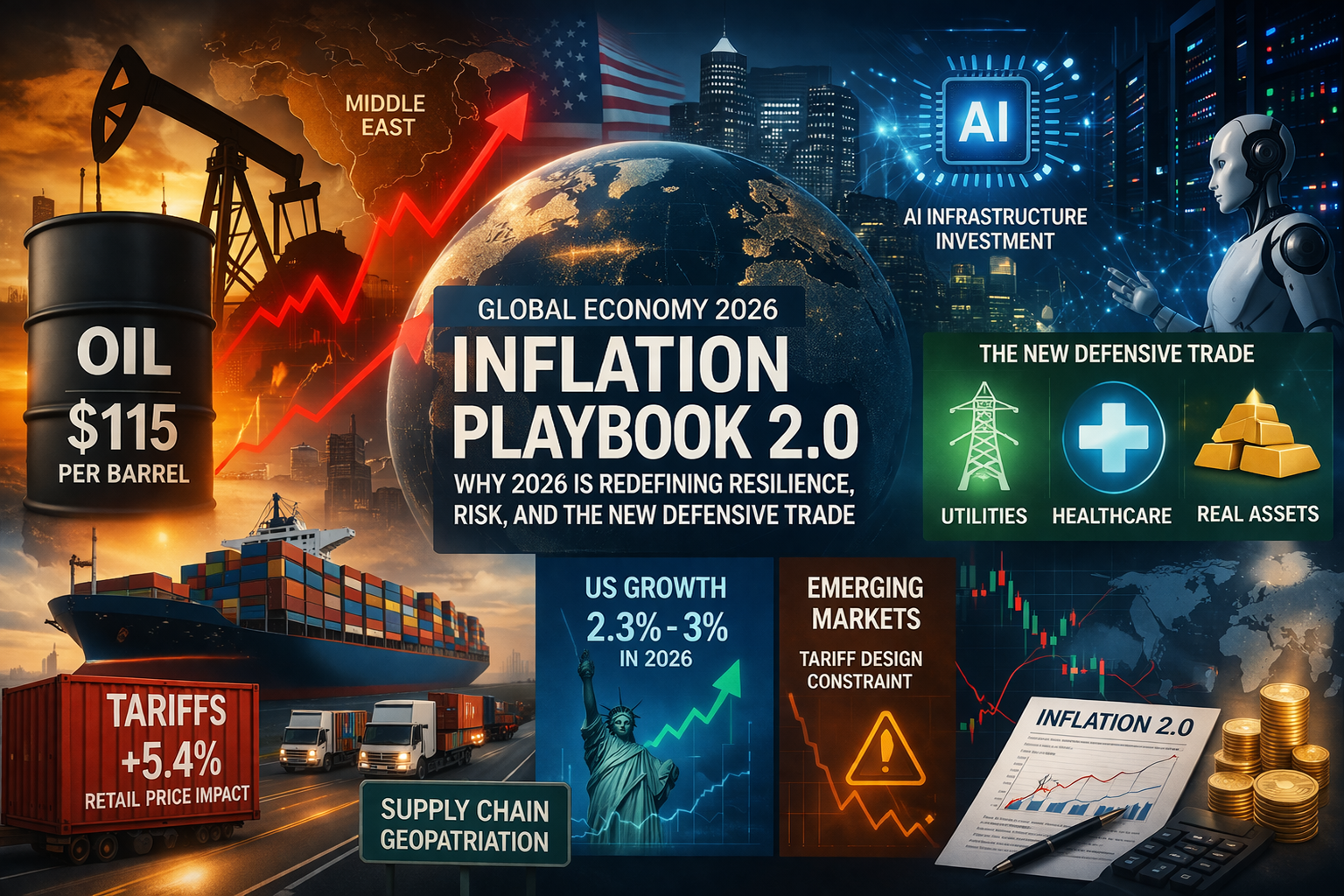
Why 2026 is Redefining Resilience, Risk, and the New Defensive Trade
- Economic Divergence: Under the Inflation Playbook 2.0, US growth growth remains high, while emerging markets face a “Tariff Design Constraint.”
- The Pivot: As part of the Inflation Playbook 2.0, investors are moving from growth-at-all-costs to Utilities, Healthcare, and Real Assets
The Era of “Tenuous Resilience”
As we enter the second quarter of 2026, the global economy is defying the “hard landing” predictions of yesteryear. However, the stability we see on the surface masks a deep, structural shift. We have moved away from the temporary “post-pandemic” inflation into what economists are calling Inflation 2.0 a cycle driven by geopolitical friction and supply chain “geopatriation.”
1. The Energy-Conflict Nexus
The primary driver of the current market volatility is the Middle East. With oil prices surging past $110-$115 per barrel in March and April 2026, the “Inflation Playbook” has been rewritten.
- The Impact: Transportation and manufacturing costs are no longer “transitory” spikes; they are now baseline operating costs.
- The Global Ripple: In the UK and Europe, inflation is expected to hover between 3% and 3.5% through Q3, forcing central banks to pause or even reverse anticipated interest rate cuts.
- Global Insight: If you are managing a global supply chain, treat energy volatility as a permanent design constraint rather than a temporary hurdle.
2. The Great Divergence: Who is Winning?
The IMF’s latest reports under the Inflation Playbook 2.0 highlight a “Divergent Force” in global growth. Not all regions are feeling the squeeze equally.
- The US Exception: Despite high rates, the US is projected to grow at 2.3%–3% in 2026, fueled by massive AI infrastructure investment.
- Emerging Markets (EMs): Countries with strong domestic demand (like India, projected at 6.2%+) are outpacing their peers. However, smaller EMs are struggling with “Time Stress” the inability to adapt quickly enough to new US trade tariffs.
- The Tariff Factor: Tariffs are no longer just political talk. By mid-2026, they have already pushed retail prices of imported goods up by an average of 5.4%.
3. The New Defensive Trade: Where the Capital is Moving
In 2026, “Safety” has a new definition. Investors are rotating out of speculative tech and into sectors that provide “Essential Resilience.”
4. How Businesses Should Pivot
If you are a business leader or a global strategist, your “Playbook 2.0” should focus on Inference Economics.
- Rebuild the Foundation: Don’t just “add AI” to old systems. Rebuild your IT as “AI-Native” to lower the long-term cost of operations.
- Sovereign Strategy: Shift critical data to regional or “sovereign” clouds to avoid the geopolitical fallout of data-sharing disputes.
- Pricing Agility: Use high-frequency data to adjust prices in real-time. With inflation being “sticky,” waiting for quarterly reviews will kill your margins.
The Bottom Line:
The global economy in 2026 isn’t breaking it’s re-sorting. Under the Inflation Playbook 2.0, the winners will be those who stop waiting for “normal” to return and start building for a world of $100+ oil, autonomous AI agents, and a fragmented trade map.
Leave a Reply