
Highlights
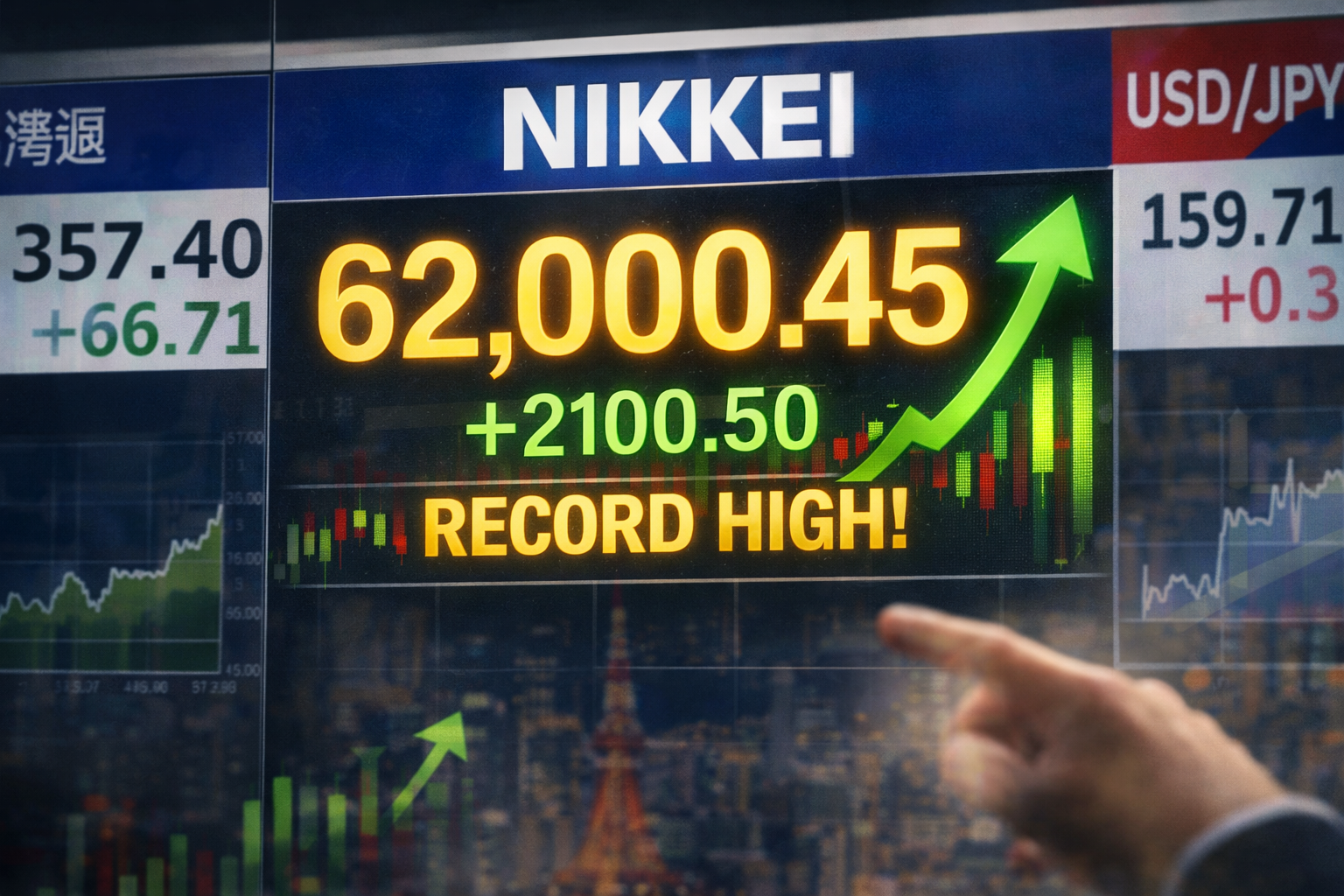
- Historic Milestone: The Nikkei 225 breached the 62,000-point mark for the first time, ending at a record high of 62,915.87.
- Record Gains: The index logged its largest-ever single-day point increase, surging over 3,400 points (a 5.7% jump) in a single session.
- Primary Drivers: Optimism over a U.S.-Iran peace deal and explosive demand for AI-linked technology shares fueled the massive rally.
The Japan stock market witnessed a historic day of trading on May 7, 2026, as the benchmark Nikkei 225 index vaulted past the psychological barrier of 62,000 for the first time in history. Returning from a multi-day holiday break, Tokyo investors unleashed a wave of buying power that propelled the index to a finish of 62,915.87. This staggering performance represented a gain of 3,402.75 points the largest single-day point increase ever recorded for the index leaving market analysts and global investors in awe of the sheer momentum within the Japanese archipelago.
The rally was not just a local phenomenon but a concentrated “catch-up” trade following several days of market closure in Japan. While the Tokyo Stock Exchange was offline for national holidays, global markets had been trending upward on cooling geopolitical tensions and a resurgence in the semiconductor sector. Upon reopening, the floodgates opened, and the Japan stock market became the focal point of Asian equity growth, outperforming regional peers like the Hang Seng and the ASX 200.
Geopolitical Relief and the AI Revolution Drive Nikkei Gains
The catalyst for this unprecedented surge in the Japan stock market was a dual-engine of geopolitical de-escalation and technological optimism. Chief among the macro factors was a significant breakthrough in Middle Eastern diplomacy. Reports emerged that the United States and Iran were nearing a comprehensive peace agreement, aimed at ending months of conflict and reopening critical shipping lanes in the Strait of Hormuz. This news triggered a sharp decline in crude oil futures and a “risk-on” sentiment that favored equities over safe-haven assets.
Simultaneously, the “AI gold rush” continues to redefine the valuation of Japanese tech heavyweights. Chip-related stocks led the charge, with companies like SoftBank Group, Renesas Electronics, and Ibiden posting double-digit gains during the session. As global demand for AI data centers accelerates, Japan’s specialized materials and semiconductor equipment manufacturers have become indispensable to the global supply chain, making them the primary beneficiaries of this liquidity surge.
Market Sentiment and the Future Outlook for Japanese Equities
As the Nikkei sits comfortably above 62,000, the broader TOPIX index also enjoyed a robust advance, rising 3.35% to end at 3,853.64. This indicates that while technology was the spearhead, the rally had broad-based support across materials, financials, and industrial sectors. Investors are also keeping a close eye on the Japanese yen, which has stabilized around 156 per dollar. A steady currency combined with record-breaking stock performance suggests that the Japan stock market is increasingly seen as a stable, high-growth environment for international capital.
Looking ahead, the question remains whether the 62,000 level will serve as a new floor for the Nikkei. Market participants are cautiously optimistic; while the “peace dividend” from the U.S.-Iran talks provides a short-term boost, the long-term structural improvements in Japanese corporate governance and the country’s strategic position in the AI hardware sector provide a solid foundation for further growth. For now, the historic point gain serves as a testament to the renewed vitality of Japan’s financial landscape in 2026.
Detailed Analysis of the Nikkei’s Record-Breaking Performance
To understand the magnitude of today’s movement in the Japan stock market, one must look at the technical “gap up” that occurred at the opening bell. After being closed since the previous Friday, the Nikkei opened significantly higher, immediately testing the 60,000 and 61,000 levels within the first hour of trade. This “limit up” behavior in several blue-chip stocks reflected a massive imbalance between buy and sell orders, as institutional investors scrambled to adjust their portfolios to the new global reality.
The sheer volume of the trade was also noteworthy. Average daily turnover on the Prime Market section reached levels not seen since the post-pandemic recovery era. Domestic retail investors, encouraged by the “NISA” tax-exempt savings accounts, joined foreign hedge funds in a coordinated buying spree. This synergy between local and international capital has transformed the Japan stock market from a stagnant “value trap” into a dynamic growth engine that is now leading the global charge into the late 2020s.
The Role of the Semiconductor Sector in the Rally
It is impossible to discuss the Nikkei’s rise to 62,000 without highlighting the semiconductor equipment and materials space. Japan currently controls a significant portion of the global market for photoresists, silicon wafers, and specialized etching equipment. In today’s session:
- SoftBank Group soared over 13% on the back of its ARM holdings and AI investment portfolio.
- Renesas Electronics jumped 13% as automotive and industrial chip demand remains insatiable.
- Ibiden Co. climbed 17%, reflecting its critical role in high-end chip packaging for AI servers.
These companies are no longer viewed merely as industrial components but as the “bricks and mortar” of the digital age. As long as the AI cycle remains in its expansionary phase, the Japan stock market is likely to remain a preferred destination for investors looking to capitalize on the next generation of computing.
Macroeconomic Implications of the 62,000 Milestone
From a macroeconomic perspective, the Nikkei hitting 62,000 marks a significant shift in Japan’s inflation narrative. For decades, Japan struggled with deflationary pressure, but the current rally is underpinned by healthy corporate earnings and a gradual return of pricing power to Japanese firms. The Bank of Japan (BoJ) is watching these developments closely. While the stock market celebrates, the central bank must balance this exuberance with the management of interest rates and bond yields.
The 10-year Japanese Government Bond (JGB) yield eased slightly during the session, suggesting that the market is not yet fearful of an aggressive rate hike. This “Goldilocks” scenario high growth, moderate inflation, and stable yields is exactly what the Japan stock market needed to break out of its historical ranges. If the peace deal in the Middle East holds and energy prices remain stable, the Nikkei could very well be looking at the 65,000 level before the end of the fiscal year.
Conclusion
The record gain on May 7, 2026, will be remembered as the moment the Japan stock market fully reclaimed its status as a global financial powerhouse. The journey from the “lost decades” to a Nikkei at 62,000 has been long and arduous, but the current momentum suggests that the rally is built on more than just speculation. With a mix of technological leadership, improved corporate efficiency, and a favorable geopolitical backdrop, the Tokyo Stock Exchange is once again the place to be.
As the dust settles on this historic session, the message to global investors is clear: Japan is no longer a side-show in the global equity markets. It is a primary driver, a leader in innovation, and a resilient market that has successfully navigated through global uncertainty to reach new, dizzying heights. Whether you are a retail investor or a multi-billion dollar fund manager, the Japan stock market and the Nikkei’s record-breaking run are impossible to ignore.
Visit Augmenting Money for the most recent information.
Leave a Reply